
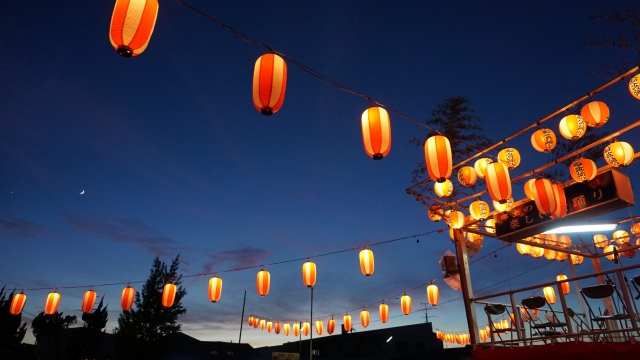
Why Japanese Festivals Move the Heart ──Festivals as Sacred Rites and the Japanese View of Faith
There are moments at Japanese festivals when the heart suddenly tightens, and tears feel close—without any clear reason why.
The steady rhythm of drums, the vivid colors of festival clothing, fireworks lighting up the night sky.
Everything overflows with energy and celebration.
And yet, beneath that brightness, something quieter reaches deep inside.
As the festival music fills the streets, warmth rises in the chest.
As portable shrines and decorated floats move through the town, the spirit lifts.
And when fireworks bloom overhead, an emotion surfaces—one that resists being put into words.
Why do Japanese festivals have this effect?
Perhaps it is because they have never been mere celebrations.
They have long been places where faith is carried—not loudly proclaimed, but quietly lived.
Festivals as Sacred Rites
Many Japanese festivals did not begin as entertainment or public spectacle.
They began as sacred rites.
Prayers for good harvests.
Wishes for protection from illness and disaster.
Gratitude offered to ancestors and to forces greater than human life.
These intentions are not always spoken aloud, but they flow beneath every festival.
Portable shrines are carried through towns because of the belief that the divine visits the land, bringing blessings to its people.
The sound of drums and chants has long been associated with driving away misfortune.
Fireworks, too, have been linked to remembrance, mourning, and the comforting of spirits.
In this way, Japanese festivals exist as moments where faith and daily life overlap—where the sacred enters ordinary space.
That is why prayer lies beneath the noise.
And why joy is accompanied by reverence and gratitude.
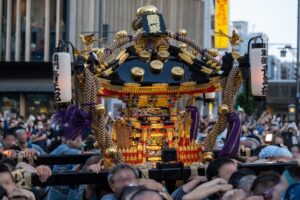
Sanja Matsuri: An Edo-Era Tradition Still Alive Today
The Japanese View of Faith and the Festival
The reason festivals have endured as sacred rites lies in how faith is understood in Japan.
Japanese deities are not imagined as distant, absolute beings watching from afar.
They are often described as yaoyorozu no kami—the “eight million gods”—a way of expressing the belief that the sacred dwells within nature itself: in mountains and rivers, wind and fire, and in things close at hand.
Festivals are moments when people and the sacred are brought into proximity.
They are also communal acts, through which entire communities express gratitude toward what sustains them.
Autumn festivals give thanks for the harvest.
Spring festivals offer prayers for the year ahead.
Festivals during Obon welcome the spirits of ancestors back into the present world.
Even at the height of excitement, a quiet sense of faith remains beneath the surface.
That quiet presence is what makes Japanese festivals feel different from spectacle alone.
What Festivals Awaken in the Japanese Heart
During a festival, there are moments when emotion rises without explanation.
As drums continue, melodies overlap, and voices merge into a single swell, something stirs—something difficult to name.
It feels as though something usually resting at the bottom of awareness briefly comes into view.
Or perhaps it is more like touching something that has always been there, unnoticed.
Many Japanese people consider themselves non-religious.
They rarely describe themselves as having faith, and they do not often speak about religion in daily life. 。
But this does not mean faith is absent.
It means that faith has blended so deeply into everyday living that it is no longer recognized as such.
There are moments when hands are quietly pressed together.
There are seasonal markers that shape the flow of time.
There is respect—toward ancestors, toward nature—that continues as habit rather than declaration.
These are not extraordinary acts.
They are part of ordinary life.
A festival may be the moment when this deeply embedded faith briefly surfaces.
What is awakened is not the question, “What do I believe?”
It is something more fundamental: the sense of the worldview one has been living within all along.
This feeling is not simple nostalgia.
It is closer to the realization, I am standing here, within this culture.
Japanese festivals move the heart because they momentarily illuminate a part of oneself that is usually unseen.
That brief illumination is what prevents them from ending as mere celebration.
When the Festival Ends
Even a town filled with festival energy returns to quiet as night deepens and lantern lights fade.
The noise, the smiles—everything recedes, almost like a dream.
A festival appears for only a few days each year.
When that brief time ends, people return to their everyday routines.
Yet what filled the heart during the festival does not disappear.
It is gently set back inside, allowed to blend once more into daily life.
Those feelings are quietly etched within and passed on.
Just as everyday customs are inherited through living itself, so too are pride and faith passed to the next generation—without display, without proclamation.
And when the next year comes, those quietly glowing feelings awaken again, breathing once more within the lights and sounds of the festival.