In Japan, it has long been believed that the divine does not reside only in special or distant places.
Kami are thought to dwell not only in nature—mountains, rivers, stones, and wind—but also in fields, homes, and human activity.
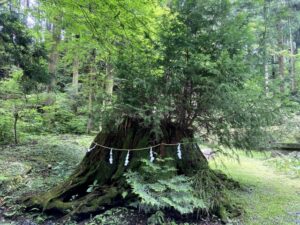
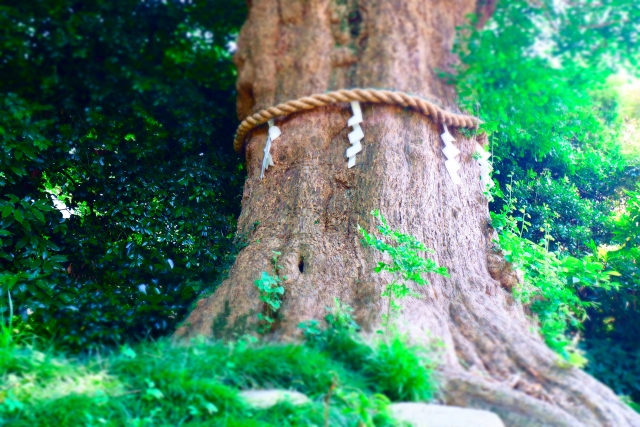
An invisible power within all things. In Japan, this essence is lived and revered as “Kami.”
This sensibility—of finding the divine in all things—is expressed in the concept of yaoyorozu no kami.
The term yaoyorozu literally means “eight million,” but it does not simply refer to a vast number of gods.
Rather, it conveys the idea that the divine can be present in everything in this world.
But what, then, is meant by “kami” in this context?
That Which Lies Beyond Human Power
In Japan, kami have been recognized through encounters with forces that lie beyond human control.
They are not necessarily beings with fixed forms, but rather the workings of nature and existence that transcend human understanding and dominion.
Flowers bloom and eventually fall.
The heat of summer passes, and the cold returns.
These natural changes are beyond the reach of human power.
In the face of such forces, people came to regard what lies beyond human control as something to be revered.
There is a kami of the mountains, a kami of the waters, a kami of the fields.
The various forces at work in nature have been understood as kami, and people have lived in awareness of their presence.
This way of recognizing diverse forces within nature has profoundly shaped the Japanese understanding of the divine.
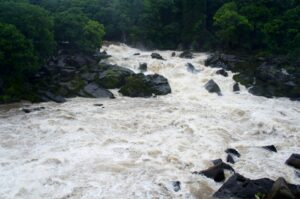
Beyond the reach of human power lies a realm. The will that resides there is known as God.
A World Where Many Kami Coexist
Unlike monotheistic traditions that center on a single, absolute god, the concept of kami in Japan is remarkably open and diverse.
Kami are not distant beings in the heavens; they are present as unseen forces in the soil beneath one’s feet and in the wind that passes through the air.
Mountains have their own kami, and seas have theirs.
There are kami that protect the fields, and others that watch over the home.
For people who have long recognized a multiplicity of forces in nature, the divine is not something to be unified into a single entity.
Each kami exists within the same world, with its own place and role.
They have not been understood as competing with one another, but as presences that govern their respective domains.
This way of seeing—of many kami coexisting—forms a fundamental aspect of the Japanese worldview.
The Worldview Revealed by Yaoyorozu no Kami
Not only nature—mountains, rivers, stones, and wind—but also human activity exists within the same world.
Human beings are not separate or exceptional; all things exist within a web of connections.
Rather than excluding what is different, there is an emphasis on acknowledging each being’s role and living together.
This perspective has shaped a core aspect of the Japanese worldview.
The blessings of nature and the disasters it can bring are not seen as opposites to be divided, but as aspects that coexist within the same force.
Instead of rejecting one side, people have sought to live in balance—accepting each aspect and finding ways to coexist.
In a land rich in nature yet constantly exposed to natural disasters, this awareness—that humans and nature, and people among themselves, exist within a network of relationships—has been cultivated through everyday life.
Yaoyorozu no Kami in Everyday Life
This way of understanding the world continues to live on in daily life.
In Japan, kami have long been seen not as distant beings, but as presences close at hand.
Shrines are built along mountain slopes and at their peaks.
In spring, the kami of the fields are welcomed down from the mountains, and in autumn, they are sent back with gratitude for the harvest.
People also engage with kami through seasonal observances such as hatsumōde (the first shrine visit of the New Year), Setsubun, and local festivals.
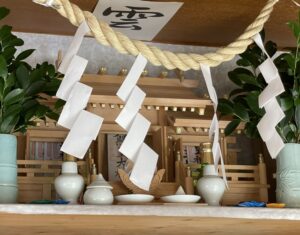
A sacred space within the home. In Japan, divinity is not distant; it is welcomed into daily life through the ritual of offering rice, salt, and water.
These annual customs can be understood as the very rhythm of life in Japan—living with nature and alongside the divine.
In this way, kami have been passed down through generations, closely tied to everyday life.
Even the same kami may differ in name and character depending on the region, and their meaning can shift according to people’s wishes.
Kami are not fixed or unchanging beings; they also reflect human intention and perception.
Why Do Japanese People See Divinity in Everything?
“The divine resides in all things.”
This way of thinking is deeply connected to the natural environment of Japan.
The Japanese archipelago has long been shaped by earthquakes, typhoons, volcanoes, and floods.
People have never been able to fully control nature, and have instead lived in constant engagement with its forces.
Mountains give rise to water, rivers nourish the fields, and wind and rain sustain crops.
Yet the same forces that bring blessings can also bring destruction.
When faced with forces beyond human control, it is natural to feel that some kind of will or power is at work.
That is why nature has not been seen as mere matter, but as something imbued with force and presence.
And this sensibility has not been directed toward nature alone.
Tools that have been used for many years, old buildings, land and place—
these too have been thought to hold something within them.
Rather than dividing the world into humans and everything else, this perspective finds life and force in all things.
That is the essence of what is meant by the yaoyorozu no kami.
To hold respect for all things around us—
this, in the end, reflects a way of living, a way of engaging with the world, that has taken shape in Japan.
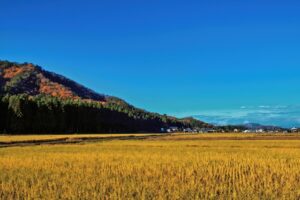
It is not only humans who are special — all things exist in connection with one another.
Further Reading:
Are the Japanese Really Non-Religious? — Understanding the Japanese View of Religion