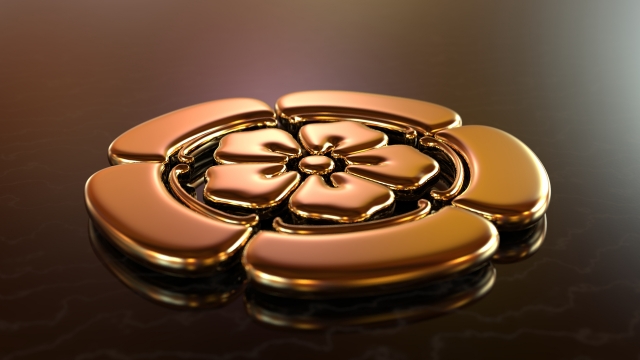
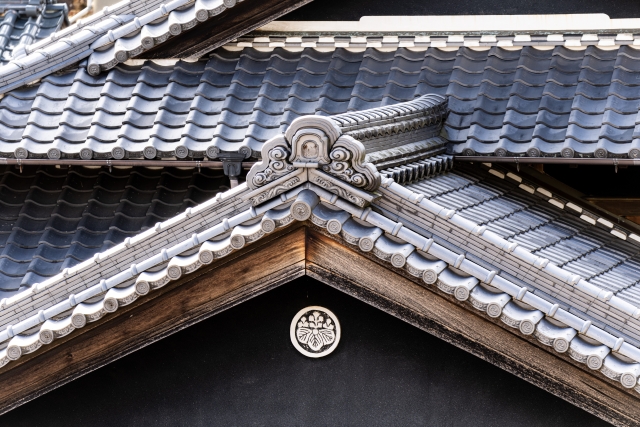
A Family crest (Kamon) that preserves the pride of a family across generations.
In Japan, there exists a symbol unique to each family, known as kamon (family crests).
These designs—featuring circles, flowers, and leaves—can be found in many places: on the roofs of shrines, on gravestones, on the backs of kimono, and on the curtains of long-established shops.
A kamon is a mark that has been passed down from generation to generation.
Yet it is not merely a symbol of bloodline.
In Japan, society has long been shaped around the unit of the “house” (ie) rather than the individual.
Within this structure, kamon have been inherited as a way of representing the existence of each family.
From the Edo period (1603–1868 CE) onward, not only samurai but also townspeople and farmers came to use kamon, and many households gradually came to have their own.
Today, however, there are few opportunities to consciously think about one’s kamon in everyday life.
Why Did Kamon Emerge and Spread?
Kamon originated as marks used to identify a household.
Their origins can be traced back to the aristocratic society of the Heian period (794–1185 CE).
Origins in Aristocratic Society
In the imperial court of the Heian period, many families gathered, carrying out ceremonies and official duties amid similar styles of clothing and furnishings.
In this setting, what mattered was not the individual, but which family one belonged to.
There was a need to indicate one’s household through personal belongings, vehicles, and furnishings.
At the time, there were no unified emblems representing specific families; status and affiliation were indicated instead through clothing colors and formal attire.
Within this context, court nobles began to apply decorative patterns to ox-drawn carriages and personal items, and these gradually came to function as marks identifying a particular household.
This practice was later passed on to the warrior class, where it gradually developed into the form recognized today as kamon.
Expansion in Samurai Society
With the rise of the samurai, kamon came to play an important role on the battlefield.
In battle, it was necessary to instantly distinguish which family someone belonged to.
For this reason, kamon were boldly displayed on flags, banners, and armor, making them visible even from a distance.
In this way, kamon came to function not merely as decoration, but as clear marks representing the presence of a household.
Even after the age of warfare came to an end, this practice remained, and kamon continued to be passed down through rituals and everyday life.
Spread Among Commoner
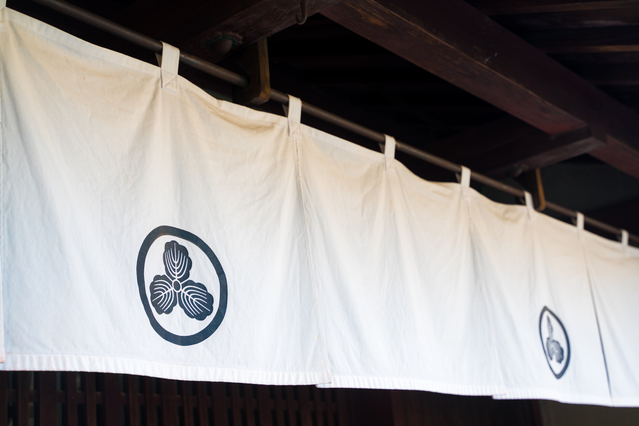
From battlefield banners to symbols of the household.
With the end of the warring era and the arrival of the Edo period, society stabilized, and people’s ways of life changed significantly.
Not only samurai, but also townspeople and farmers came to live as households, and the idea of the “house” became more deeply rooted across society.
In this context, kamon spread beyond the warrior class and came to be used among common people as well.
Merchants displayed them on shop curtains and signboards, while farming families used them in festivals and weddings.
In this way, kamon became established as marks representing each household.
Here, their role shifted—from identifiers used on the battlefield to marks expressing the presence of a household within everyday life.
The Meanings Embedded in Kamon
It is said that there are tens of thousands of variations of kamon.
Even when based on the same motif, subtle differences emerged and were passed down within individual families.
Motifs such as plants, animals, and geometric forms each carry their own meanings and wishes.
Through kamon, it is possible to understand what a family has valued over time.
Aoi (Hollyhock)
The aoi crest is known as a symbol of authority and prestige.
The hollyhock has long been regarded as a sacred plant and treated as something imbued with special meaning.
It is also known as the emblem of the Kamo Shrines in Kyoto—Kamigamo Shrine and Shimogamo Shrine—and its name lives on in the Aoi Matsuri, a traditional festival held there.
As a kamon, the “Mitsuba Aoi” (three-leaf hollyhock) of the Tokugawa family is especially well known.
This design, in which three hollyhock leaves are arranged in a circular form, has been passed down through the Tokugawa lineage and related families, and can still be seen at sites associated with them, such as Nikkō Tōshōgū and Zōjō-ji Temple.
For this reason, the aoi crest continues to serve as a symbol that directly evokes the Tokugawa family.
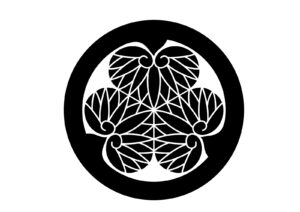
The triple hollyhock crest, famous as the Tokugawa clan’s family emblem
Kiri (Paulownia)
The kiri crest is widely known as a symbol of prosperity and authority.
The paulownia tree, which grows quickly and bears large, beautiful leaves and flowers, has long been regarded as a plant symbolizing abundance and flourishing.
Originally, it was a crest associated with the emperor and the imperial family and was considered highly prestigious.
Later, its use was granted to distinguished warriors and court nobles, and it gradually spread more widely.
Among its variations, the “Gosan no Kiri,” used by Toyotomi Hideyoshi, is particularly well known.
This design, with five flowers in the center and three on each side, became associated with the figure of a ruler and left a strong impression on people.
Today, the “Goshichi no Kiri,” used as the emblem of the Japanese government, continues this lineage.
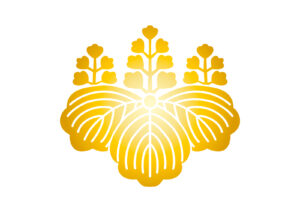
The “Goshichi-no-kiri” paulownia crest, the official emblem of the Japanese government.
Mokko(Quince)
The mokko crest has been used as a symbol expressing wishes for the continuation of descendants and the stability of the household.
There are several theories regarding its origin.
Some suggest it is based on the cross-section of a melon, while others say it represents a bird’s nest.
In either case, they share the common meaning of wishing for family prosperity and stability.
The typical mokko design has four lobes, but the version used by the warlord Oda Nobunaga, known as the “Oda Mokko,” is distinguished by its five-lobed form.
Originally used by court nobles, this kamon spread to warriors and townspeople as family crests became more widely adopted, and it is now known as one of the representative kamon of Japan.
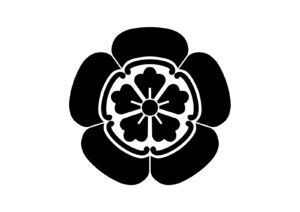
The “Oda mokkō” crest, characterized by its five-petaled design.
Fuji (Wisteria)
The fuji crest is known as a symbol of elegance and prosperity.
The wisteria flower, with its gracefully hanging clusters, has long been familiar to people in Japan.
Its beauty was loved by aristocrats of the Heian period, and it gradually came to be adopted as a motif for kamon.
Wisteria is associated with elegance, prosperity, and longevity, and its softly cascading form has also been linked to wishes for family continuity and stability.
The Fujiwara clan is one of the most well-known examples associated with this crest.
This powerful family of the Heian period incorporated “fuji” into their name and used it in their kamon.
Through their influence, the fuji crest spread as a symbol of prestige and was later passed down to warrior and merchant families.
Over time, variations emerged in the number of clusters, branching patterns, and leaf arrangements, resulting in a wide range of designs.
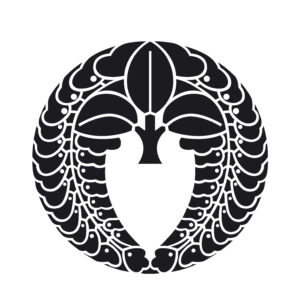
An elegant wisteria crest.
Taka no Ha (Hawk Feathers)
The taka no ha crest is known as a symbol of strength and martial valor.
This design, depicting sharply extended feathers, is one of the motifs that conveys a particularly strong impression among kamon.
The hawk, admired for its hunting ability and keen intelligence, was favored by the samurai, and its feathers were also used as fletching for arrows in traditional Japanese archery.
For this reason, the taka no ha crest was widely used among warrior families and came to be known as one of the representative kamon of Japan.
Its composition typically consists of one, two, or three feathers arranged in parallel, giving it a simple yet well-balanced form.
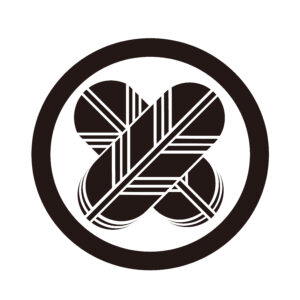
Its composition typically consists of one, two, or three feathers arranged in parallel, giving it a simple yet well-balanced form.
Kamon in the Modern World
In the past, kamon were widely used in everyday life as marks representing each household.
In modern society, however, where the individual has become the primary unit, there are fewer opportunities to consciously think about them.
Even so, kamon have not disappeared, and they continue to remain in various settings—such as ceremonies, traditional clothing, temples, shrines, and long-established businesses.
Within them, one can still find a way of viewing the world centered on the household, carried forward while changing form.
Each kamon carries the origins of a family and the thoughts of the people who lived before, passed down over a long span of time.
To look closely at kamon is also to come into contact with one’s own roots and with the accumulation of Japan’s history and culture.
What meaning might be embedded in your kamon?