Daruma Doll — Zen and Japan’s Folk Faith

Language
だるま──禅と日本の民間信 Craftsmanship


Daruma — Zen and Japan’s Folk Faith


A round red body and a stern, dignified face.
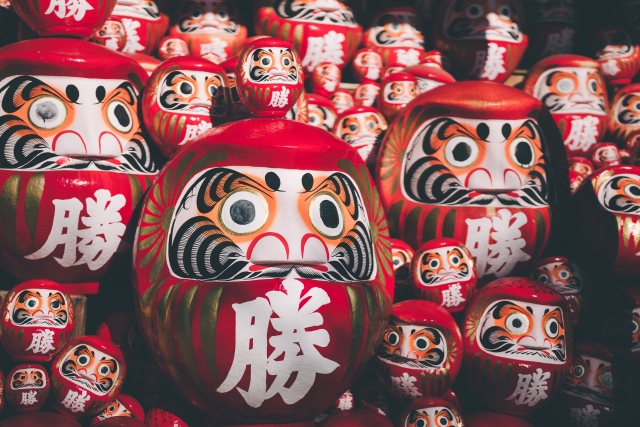
The daruma is one of the most familiar good-luck charms in Japan.


And yet, despite how deeply it is rooted in everyday life, surprisingly few people can clearly explain its origins, its meaning, or the proper way to handle it.


Why it is kept with one eye unpainted, why red became the standard color, and why it is returned to temples and shrines at certain milestones—
the daruma is an object that gives visible form to people’s “wishes” and “goals” and places them quietly within the flow of daily life.

It is a talisman of good fortune, but at the same time it helps us organize our actions and mark the turning points of our lives.


In what follows, we will trace the history, symbolism, and customs surrounding the daruma, and from there consider how Japanese folk belief has grown out of, and remained embedded in, everyday living.


The Origins of Daruma — From Zen Icon to Lucky Charm


Anyone raised in Japan has almost certainly seen a daruma at least once.
Far fewer, however, are consciously aware that its name goes back to Bodhidharma (Daruma Daishi / Bodai Daruma), revered as the patriarch of Zen.

Loved today as a cheerful red good-luck charm, the daruma has also long carried the weight of qualities such as perseverance and an unyielding spirit.


Bodhidharma, First Patriarch of Zen


Bodhidharma is said to have traveled from India to China in the early sixth century CE and has been spoken of as the “first ancestor” of Zen. His figure lies somewhere between history and legend, but he is remembered above all as a monk who devoted himself to seated meditation.


Zen places less emphasis on scriptural words alone than on disciplining the mind through practice and grasping truth from that experience.

As the core of that practice, great importance came to be placed on zazen—silent seated meditation that aims at a state of no-mind, free from distraction.


Against this background, Bodhidharma came to be seen as an emblem of absolute focus: a figure who gives himself wholly to what is before him and does not easily waver.

※For more on zazen, see the separate article:Zazen — The State of “Nothingness” Found in Stillness


達磨大師像

Statue of Bodhidharma (Daruma Daishi).


From Bodhidharma to “Daruma”


Over time, the name and image of Bodhidharma entered more deeply into everyday life.

At temple fairs and shrine markets, people sought tangible things they could take home—objects that could carry their prayers and resolutions. Images of Bodhidharma came to serve precisely that role.


While retaining the aura of a stern ascetic, ordinary people layered onto him their own resolve “to keep going” and “to start again,” and began keeping his likeness close at hand in a visible, graspable form.


In this way, Bodhidharma gradually transformed—from a symbol of Zen practice into the “daruma,” a lucky charm that supports people’s wishes and goals.


Paper-Mache Daruma and the Birth of Daruma Markets


When we speak of the daruma as a talisman, paper-mache daruma are indispensable.

Using a wooden mold, layers of Japanese paper are applied and formed. Because papier-mâché is light, easy to handle, and allows the same shape to be reproduced again and again, daruma were able to spread as familiar, everyday objects of good fortune.


The gateway through which daruma became firmly established is what are known as “daruma markets.”

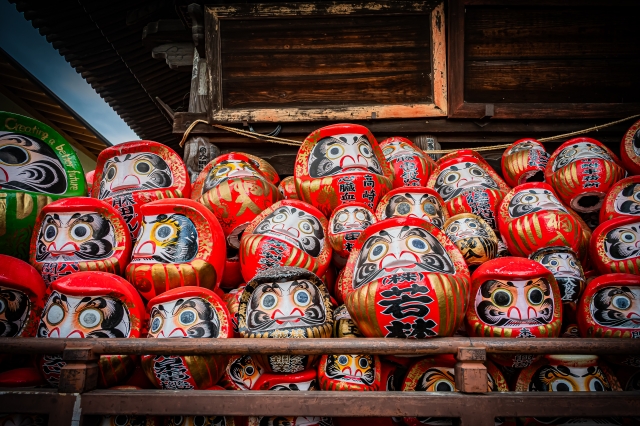
Held mainly around the New Year as fairs at temples and shrines, these markets are crowded with people seeking auspicious new daruma. Dates and scale vary from region to region, but they have long been cherished as places where one sets wishes and goals at the beginning of the year or at other turning points.


Stalls are lined with daruma in every size and expression, and people choose the faces and sizes that speak to them as they give shape to the hopes they will entrust to the coming year.
More than simply places of purchase, daruma markets have functioned as spaces where people “set their intentions” and “reset their minds” at the year’s start.


Because such places existed, the daruma took root not only as a charming talisman but also as part of living culture.
Daruma markets continue across Japan today, established as annual observances that carry forward a continuity reaching back to the Edo period (1603–1868).


正月のだるま市

New Year Daruma market.


The Daruma as Talisman


In the daruma, form, color, and custom each carry clear layers of meaning.
Part of the reason it has become so widely established as an auspicious object lies in this clarity—its symbolism is easy to comprehend.


“Fall Seven Times, Rise Eight”


The daruma’s rounded body is designed so that, if you push it over, it rights itself again.
In this sense, it mirrors the course of a human life.

Its low, steady center of gravity symbolizes the mental strength and endurance needed to face hardship, as well as the inner stance that sustains them.


Life does not go well at every step. Failure and setback are part of the path.
Even so, we stand up again each time and move forward once more.


Wishes Held in Color


For many people, the word “daruma” immediately calls to mind the color red.

This red is often linked to traditions that say Bodhidharma, from whom the daruma takes its name, wore scarlet robes.


At the same time, red has long been associated with warding off misfortune and evil.

In eras when illness and calamity were constant threats, people saw red as a “protective color.”


When smallpox epidemics spread, for example, there was once a custom of hanging red-accented pictures (hōsō-e) in homes to pray for protection from disease. The red of the daruma is not merely decorative; it is a color that gives visible form to the desire to safeguard everyday life.


Painting the Eyes — Giving Shape to a Wish


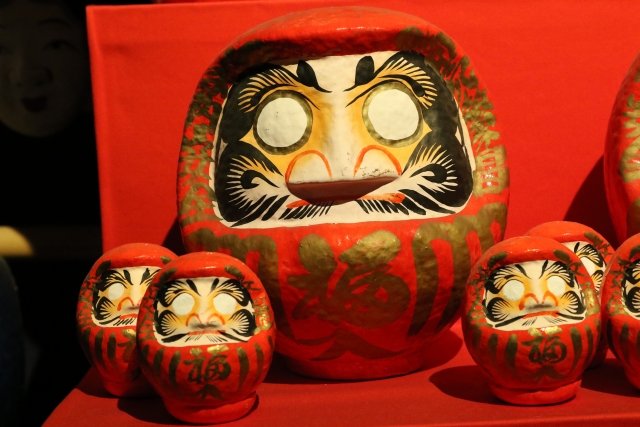
One of the most widely known customs surrounding the daruma is “filling in the eyes.”

When a person sets a wish or goal, they paint in one eye.
When the wish is fulfilled, or when they reach a significant milestone, they paint in the other.
Only when both eyes are complete is the daruma considered to signify the fulfillment of a great wish.


だるまの目入れ

Filling in the eyes of a Daruma doll.


This practice keeps the wish from fading by giving it visible form and placing it directly within the field of daily life.
Each time one’s gaze catches on a one-eyed daruma, it becomes a prompt to return to one’s original resolve.


Eye-painting has been passed down to this day as a way of linking intention to the everyday efforts that ultimately give it substance.


Returning the Daruma — The Meaning of Closure


There is also an established custom of returning the daruma to a temple or shrine once a wish has been fulfilled, or when the year draws to a close.
An old daruma is respectfully let go, and a new one is welcomed in its place.


Japanese has expressions such as “bringing something to a beautiful close” and proverbs that stress the importance of endings. As these suggest, there has long been a cultural emphasis on how things are completed.


In the culture of returning daruma, meaning is placed not only on holding a wish or on whether it was visibly fulfilled, but on giving that process a proper ending.


Because there is a clear moment of closure, people can compose themselves and move on to their next wish.


Even when things do not unfold as planned, bringing a daruma back at a seasonal turning point allows people to draw a line and move forward.
In many temples and shrines, returned daruma are ritually honored and consigned to the flames in an otakiage ceremony.

By having a shared, recognized way of letting go, people are able to step into the next year and toward the next set of intentions.


The Regional Faces of Daruma


Daruma are made all over Japan, but they do not all look the same.

Facial expression, the way eyebrows and beards are painted, the characters written on the body, colors, sizes—change the region, and the daruma’s face and role change with it.

What we see is not simply the result of individual artisans’ preferences.

Each regional style reflects the beliefs and ways of life of the community that raised it.


Takasaki Daruma (Gunma)


In Japan, many people will think first of Takasaki when they hear the word “daruma.”

Centered on the city of Takasaki in Gunma Prefecture, Takasaki daruma have become the standard-bearers of papier-mâché daruma and are often regarded as the model that shaped the “modern” daruma form.


One of their most distinctive features is the way eyebrows and beard are painted with auspicious meanings in mind. The eyebrows are likened to cranes, the beard to a turtle; in this way, motifs of crane and tortoise—symbols of longevity and prosperity—are woven into the face itself.


On the body, large characters such as “Certain Victory” or “Prosperous Business” are written, tying the daruma directly to specific goals and results. The fact that they are used not only for personal vows but also for prayers for success in companies and organizations speaks to the pragmatic role Takasaki daruma have come to play.


高崎だるま

Daruma dolls at Shorinzan Daruma-ji Temple in Takasaki, Gunma Prefecture.


Mihara Daruma (Hiroshima)


Mihara daruma, a local craft of Mihara City in Hiroshima Prefecture, are recognizable by their elongated bodies and the polka-dot headscarf pattern painted across the head. Both eyes are painted from the beginning, with the wish “to see the way ahead clearly” embedded in their design.

Production began in the Edo period as a talisman to ward off epidemics, and later spread as a side occupation among samurai in this castle town.


Each February, the Mihara Shinmei-ichi fair is held, and countless daruma are sold; the festival itself has become so closely tied to the craft that it is widely known as a “daruma market.”


三原だるま

Mihara Daruma


Matsukawa Daruma (Miyagi)


Matsukawa daruma represent Sendai’s tradition of papier-mâché figures. Unlike the solid red associated with many daruma, their fronts are boldly painted in deep or light blues.
These colors are said to evoke sky and sea, and gold powder is sometimes scattered across the surface, adding a festive brilliance.


Another striking feature is that both pupils are painted in from the outset. One explanation links this to consideration for Date Masamune, the one-eyed lord of the Sendai domain; another tells that the daruma “watches over all directions.”


Production is said to have begun in the Tenpō era (1830–1844), when samurai retainer Matsukawa Toyonoshin took up the craft. As with Mihara daruma, it is thought to have spread as supplementary work among warriors.


松川だるま

Matsukawa Daruma


The differences we see from region to region are not simply the result of artisans’ ingenuity.

They exist because local climate, local hopes, and the everyday life people wish to protect have all found expression in the daruma’s form.


In merchant towns, they carry prayers for thriving business.
In farming regions, wishes for good harvests and the safety of the household.

From place to place, the daruma has quietly adjusted its appearance to local needs, standing watch over the everyday lives lived there.


What Stands Beside Our Wishes


The daruma is not an object that, by itself, “grants” anything.

Rather, it has taken on the role of a companion to daily life—something close at hand that supports the wishes and resolve of the people who live beside it.


There are times when a wish goes unfulfilled and the daruma remains with only one eye.
There are stretches when nothing seems to go right.

Even so, simply having a daruma within sight can create a moment in which we feel we can begin again.


In the unsteady rhythm of ordinary days, the daruma offers a quiet point of return—a still place that helps us face forward once more.


だるまと夕日


コメント

Copied title and URL