Exploring the Flavors of Home – Akita Edition
Facing the Sea of Japan and framed by the ridge of the Ōu Mountains and broad plains, Akita Prefecture is known as one of Japan’s major rice-growing regions.
Here, in a land where winters are long and snowbound, people have developed ways of preserving and fermenting food with the cold season in mind, and a food culture that makes full use of what the sea and the mountains provide.
The steam rising from a pot of newly harvested rice, the deep aroma of fish sauce lifting from the stove, the smoky notes that linger softly at the end of a meal—Akita’s local dishes are the crystallization of techniques honed through living with a harsh natural environment.
In this article, we will explore the “flavors of home” that have taken root in Akita Prefecture.
Kiritanpo Hot Pot (Kazuno / Ōdate)
Kiritanpo is said to have its roots in the Kazuno area in northern Akita.
It began as a way to shape cooked rice into a portable form that could be eaten easily during forestry work or hunting, and from there it evolved into a hot pot dish.
In its region of origin, any hot pot that includes tanpo is broadly called kiritanpo-nabe, and it first became established as a mountain dish that prioritized practicality.
In neighboring Ōdate, however, it was refined as a “festive day” dish served at home, and later, through restaurant offerings, the style was polished into the “Akita specialty” that is known today.
It is easy to picture how, in homes with an irori hearth, grilled tanpo naturally found its way into the pot.
When combined with winter vegetables such as burdock root, leek, and Japanese parsley (seri), the aroma of rice layers with the flavor of the vegetables to create a nourishing hot pot well suited to a snowy winter climate.
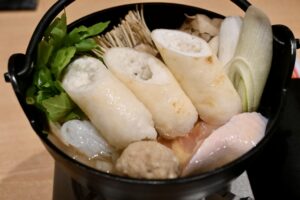
Kiritanpo hot pot, a specialty of Akita Prefecture.
Miso-Tanpo (Northern Akita)
Up to the stage where pounded rice is wrapped around a stick and grilled, miso-tanpo is made in the same way as kiritanpo.
The difference is that instead of going into a hot pot, the freshly grilled rice is brushed with a slightly sweet miso sauce and eaten as is.
The charred surface of the rice and the richness of the miso complement each other, and the fact that you can hold it in your hand and bite straight in is part of its appeal.
As a way of eating that brings together Akita’s miso culture and rice culture, it has long been popular mainly in the northern part of the prefecture.
A tanpo grilled over the household hearth, with miso spread over it and eaten during a break from mountain work or around the irori—such scenes have been familiar in Akita since long ago.
Where the hot pot version embodies kiritanpo as a “special dish,” miso-tanpo has stayed close to daily life as a “snack-style kiritanpo.”
Today it is a common sight at tourist spots as well, and is widely enjoyed as an easy way to taste Akita.
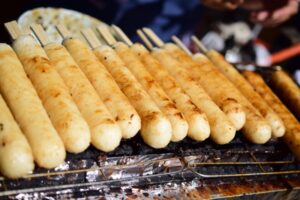
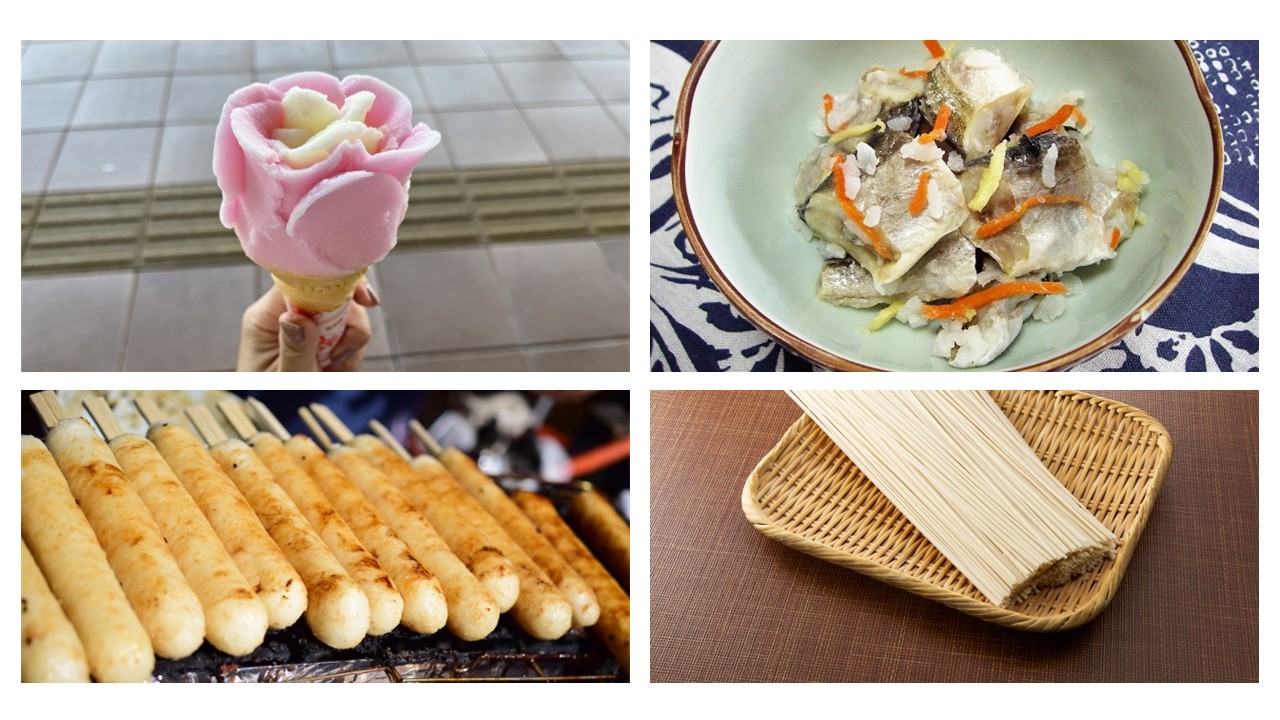
Miso-tanpo: grilled kiritanpo rice sticks coated with sweet miso, a popular snack at tourist spots.
Hinai-Jidori Chicken (Ōdate Area / Northern Akita)
Hinai-jidori, one of Japan’s three most renowned local chicken breeds, is often mentioned as the key to the flavor of kiritanpo hot pot.
Its value, however, lies not only in the meat itself but also in the broth it produces.
While its firm, substantial texture is highly regarded, what really sets hinai-jidori apart is how the sweetness and richness of its fat slowly melt into the pot, adding weight and depth to the soup as a whole.
Produced mainly in northern Akita, hinai-jidori has been used in everything from family hot pots to restaurant specialties.
In kiritanpo hot pot, the chicken does not simply stand out as the sole “star.”
Rather, it plays the role of bringing together the character of the tanpo and vegetables and rounding off the dish overall.
In many respects, it is the power of the broth, more than the individual ingredients, that determines how good a pot of Akita-style kiritanpo will be—
and hinai-jidori sits at the heart of that flavor.
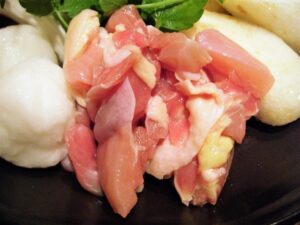
Hinai-jidori, one of Japan’s three top jidori chicken breeds.
Inaniwa Udon (Yuzawa / Inaniwa)
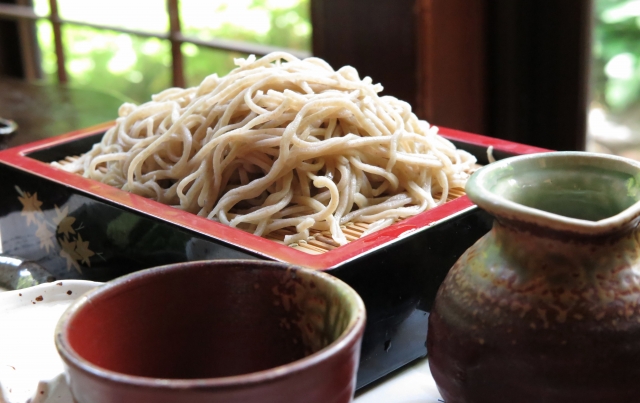
Inaniwa udon is a hand-stretched dried udon noodle that has been passed down in the Inaniwa area in the south of Akita Prefecture.
According to local tradition, its origins go back to around the Keichō era (early 1600s), and it is said to have been served as a tribute to feudal lords.
In snowy regions, many households prepared foods that would keep well through the winter.
Dried noodles store easily and can be used quickly whenever needed.
Behind the development of Inaniwa udon lies this kind of everyday wisdom.
The long, slender noodles have a smooth texture and a clean, gliding swallow.
Served chilled, their lightness stands out; served in a hot broth, they are slow to lose their shape.
Being able to enjoy them in different styles depending on the season and occasion is one of the charms of Inaniwa udon.
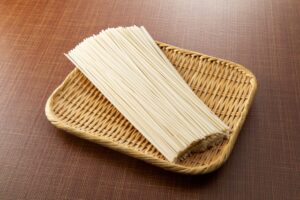
Inaniwa udon, long-lasting dried noodles essential to snowy regions.
Shottsuru Hot Pot (Oga and Coastal Areas)
No discussion of Akita’s fermentation culture would be complete without shottsuru, a local fish sauce.
Made by salting fish such as hatahata (sandfish) and leaving them to ferment and mature over time, it is a seasoning that condenses umami and has long been familiar on local tables.
Shottsuru is often introduced as one of Japan’s three major fish sauces, and is positioned as a defining condiment of Akita.
Because it has a strong umami and pronounced aroma even in small amounts, the way it is used can significantly affect the finished hot pot.
When shottsuru is added to broth as the main source of salt, and tofu, leek, Chinese cabbage and other ingredients are combined with it, its savoriness spreads easily throughout the pot.
Hatahata itself has a delicate character.
Its flesh is mild, and its roe, known locally as buriko, also has a fine, subtle texture.
Precisely because the ingredients are gentle in flavor, the depth of shottsuru supports them, so the taste does not seem thin even as you keep eating.
Transforming fish landed along the coast into a seasoning through fermentation, and then putting that seasoning to work in an everyday hot pot—
shottsuru-nabe is an Akita-style dish that draws together the bounty of the fishery and the knowledge of preservation and maturation.
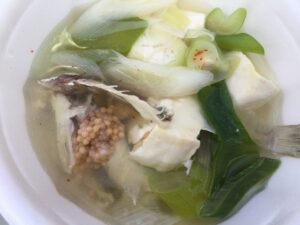
Shottsuru hot pot made with Akita’s signature fish sauce, pairing rich umami with the delicate hatahata fish.
Hatahata Sushi
The hatahata used to make fish sauce also holds an important place as a year-end and New Year fish in Akita.
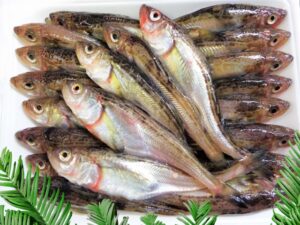
Hatahata, an indispensable fish in Akita.
In some areas, people say, “You can’t properly welcome the New Year without hatahata.”
Hatahata-zushi is made by marinating this fish together with rice and kōji (malted rice) and allowing it to ferment and mature.
The distinctive point of this dish is that a method originally developed to preserve fish through fermentation has, as it is, taken root as a New Year’s food.
In rice-growing Akita, rice and kōji form the foundation of daily eating, and it was natural that they should also be used to preserve hatahata.
A technique born for the sake of preservation became intertwined with the year-end and New Year festivities, and has remained as a staple on the holiday table.
Details such as how the fish is prepared, the composition of the marinade, and the degree of maturation vary from household to household.
Even though it is the same “local dish,” each family’s way of making it shows through in the final flavor, and those variations have been passed down across generations.
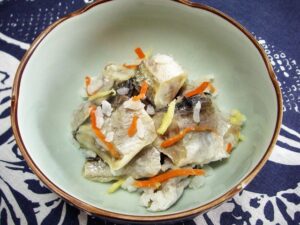
Hatahata sushi, a traditional New Year dish in Akita.
Iburigakko (Southern Inland Areas)
Iburigakko is a pickled daikon radish that was created in areas of heavy snowfall where sun-drying vegetables outdoors does not go smoothly.
Because daikon could not be dried sufficiently outside, people hung the radishes above the irori hearth, using heat and smoke both to remove moisture and to impart aroma.
This method, devised simply as a way to make dried daikon, evolved directly into an “Akita-style” smoked pickle.
The process can broadly be divided into two stages.
First, the daikon is smoked to drive off moisture and absorb a unique smokiness.
Next, it is packed in rice bran and left to ferment and mature over time.
The smoke forms the backbone of the fragrance, while the rice bran adds acidity and umami, giving the flavor depth.
In recent years, combinations such as iburigakko served with cheese have drawn attention, but at its core this pickle remains a food born of the wisdom of getting through the winter.
A preserved food honed by life in a snowy region has now become a representative presence in Akita’s pickle culture.
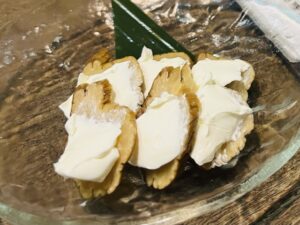
In recent years, pairing iburigakko with cream cheese has become a popular way to enjoy it.
Babahera Ice (Throughout Akita)
Seen along roadsides and at event venues in Akita, babahera ice is a type of ice cream sold from roadside stands by older women who deftly shape it with a flat spatula.
The name is widely said to have originated when local high school students combined baba (“old lady,” referring to the vendor) and hera (spatula).
Its appeal lies above all in the way it is served.
With nimble movements, the vendor layers the ice little by little into the shape of a flower.
The way the petals gradually appear on the cone is enough to make passersby stop and look.
The sight of these stands lined up along arterial roads or set up at festivals has become a familiar summer scene in Akita.

Baba-hera ice cream, shaped like flower petals.
Akita’s food culture has been built under the conditions of a heavy-snow region, with rice and fermentation at its core in shaping local “ways of eating.”
Hot pots warm the body; pickles and fermented foods provide both keeping quality and depth of flavor; dried noodles help carry households through the winter months.
Kiritanpo and shottsuru, hatahata-zushi and iburigakko—none of them is flashy.
Each is a traditional taste in which the ingenuity of everyday life has taken on a lasting form.
The more attention you pay to the lives behind these dishes, the more Akita’s local cuisine reveals just how fascinating it is.
“Exploring the Flavor of Home” Series
・Hokkaido : Exploring the Flavors of Home – Hokkaido Edition
・Aomori : Exploring the Flavors of Home – Aomori Edition
・Iwate : Exploring the Flavors of Home – Iwate Edition