What is Osechi Ryōri, the Symbol of Japanese New Year?
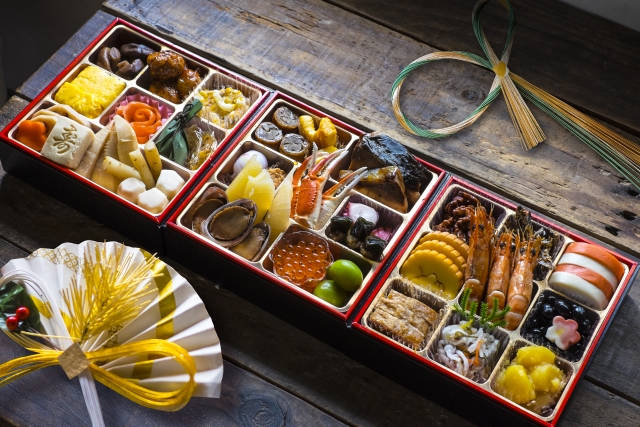
On New Year’s morning in Japan, a set of tiered lacquered boxes is placed on the family table.
Open the lids, and you will find neatly arranged dishes in vivid colors—black beans, herring roe, rolled omelet, and more.
For those who grew up in Japan, it is a familiar sight.
For someone seeing it for the first time, it may look a little mysterious.
This New Year’s cuisine, known as osechi ryōri, is far more than a luxurious celebratory meal.
Originally, it was an offering to the deity of the New Year, and each item was prepared with a specific wish in mind—good health, long life, prosperity of descendants, abundant harvests, and so on.
Even the act of stacking the food in tiered boxes carries meaning: a wish that “good fortune may be piled up layer upon layer.”
In what follows, we will trace the history and development of osechi ryōri and the meanings behind each of its dishes, while turning our attention to the hopes that people in Japan have placed on the year that is about to begin.
The History and Origins of Osechi
The history of osechi ryōri is said to stretch back more than a thousand years.
Its origins lie in court rituals of the Heian period known as sechie, seasonal banquets held at the imperial court.
At these sechie, food was offered to the kami (deities), and people gathered to share those blessings and enjoy a feast together at each seasonal turning point.
This idea of “festive dishes for seasonal milestones” gradually spread among commoners and, over time, was especially anchored in the New Year, the starting point of the calendar year.
By the Edo period, the now-familiar style of packing dishes into tiered boxes had become widespread.
In an age before refrigeration, the focus was on foods that would keep well. Families traditionally prepared everything by New Year’s Eve.
During the first three days of the year, people were to use fire as little as possible and “rest the kitchen.”
It is said that this custom also reflected a wish that, at least during the New Year, families—especially the women responsible for cooking—could be freed from daily housework.
The Contents of Osechi and Their Meanings
Each dish placed in osechi ryōri carries its own wish or prayer for the year ahead.
Here are some of the most representative items.
Kuro-mame (black soybeans)
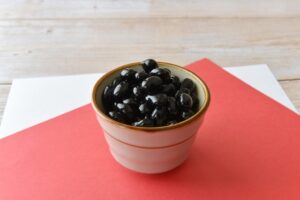
Through a play on words—mame ni hataraku (“to work diligently”) and mame ni kurasu (“to live in good health”)—black beans are eaten as a wish for health and industriousness.
Kazunoko (herring roe)
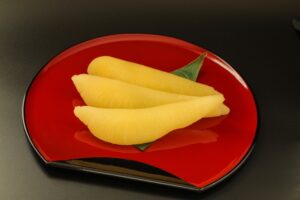
Herring eggs symbolize the prosperity of descendants. The word nishin (herring) can be written with characters meaning “two parents,” and the countless tiny eggs evoke “many children born from two parents.”
Their delightful popping texture makes them a staple of New Year celebrations.
Tazukuri
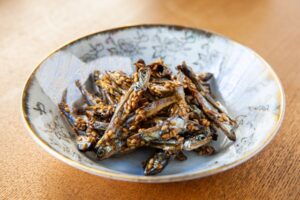
Small dried sardines simmered in a sweet-savory glaze.
Because sardines were once used as fertilizer in rice fields, this dish is associated with prayers for rich harvests and the abundance of the five grains.
Kuri-kinton (sweet chestnut paste)
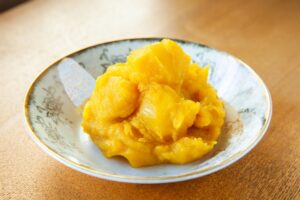
Its golden color calls to mind treasure or gold ingots, and so it is eaten with wishes for financial fortune and a prosperous year.
Its gentle sweetness makes it popular with both children and adults.
Kōhaku kamaboko (red-and-white fish cake)
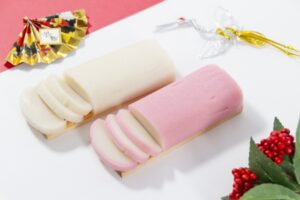
The red and white color scheme represents festivity and protection from evil, while the semicircular cross section is said to resemble the first sunrise of the year.
For these reasons, it has long been regarded as fitting for celebratory occasions.
Kobumaki (kelp rolls)
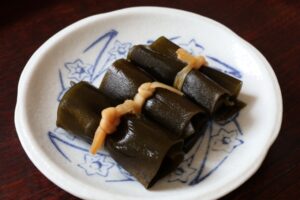
Kelp (konbu) is linked by wordplay to yorokobu (“to rejoice”), and has been used in celebratory dishes since ancient times.
The deep flavor of the broth, combined with the rolled form, embodies a wish that “joy may continue for many years to come.”
Datemaki (sweet rolled omelet)
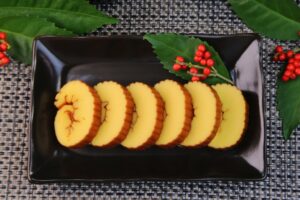
Its rolled shape evokes scrolls of writing or books, and it is often said to symbolize success in learning and the flourishing of culture and scholarship.
With its bright, rich color, it brings visual warmth to the inside of the jūbako (tiered boxes).
The Meaning of the Tiered Boxes
For many people, the image of osechi ryōri is inseparable from the jūbako, the tiered lacquer boxes in which the food is packed.
The act of “stacking” the dishes symbolizes a wish that “good fortune and happiness may be stacked up in many layers.”
The number of tiers and the way they are filled varies by region and household, but a commonly cited example looks like this:
- First tier (ichi no jū): Festive dishes called iwai-zakana—black beans, herring roe, tazukuri, red-and-white fish cake, and so on.
- Second tier (ni no jū): Vinegared dishes and small side items such as red-and-white namasu (pickled daikon and carrot), kobumaki, and pickled lotus root.
- Third tier (san no jū): Grilled and simmered dishes like teriyaki yellowtail, prawns, and assorted simmered vegetables. (nishime or nimono)
- “Yo no jū” (fourth tier in a four-tier set): A flexible layer for balancing foods from the sea and the mountains, or for including family favorites—sometimes called the “free” or “extra” tier.
The character for “four” (shi) is often avoided because it can be associated with the word for “death,” and the alternative reading “yo” is used instead. This sensitivity to wording is itself very Japanese.
Today, many families opt for two- or three-tier sets to match their household size and appetites.
Even so, the basic form—“stacking dishes in layers”—remains unchanged as a symbol of the New Year.
Osechi in a Changing Present
In the past, it was common for families to spend several days at the end of the year preparing osechi together.
With the rise of dual-income households and changes in lifestyle, more and more people now order ready-made osechi from department stores, traditional restaurants, specialty shops, or online retailers offering frozen sets.
While most sets still include the time-honored staples, their contents have diversified to fit modern tastes, for example:
- Western-style items such as roast beef or gratin
- Chinese-style osechi featuring dishes like shrimp in chili sauce or sweet-and-sour pork
- Compact, beautifully arranged “single-serving” or “for two people” sets
At the same time, traditional dishes like black beans, herring roe, and simmered vegetables remain firmly in place, with many people feeling that “it just doesn’t feel like New Year without them.”
The flavors and presentation may evolve with the times, but the role of osechi—a cuisine for welcoming the new year together with heartfelt wishes—continues unchanged.
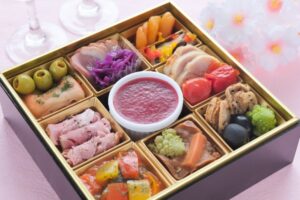
Osechi has evolved and diversified with the times.
What Osechi Tells Us About the Japanese New Year
For all its visually lavish appearance, osechi ryōri is, at its core, a collection of modest prayers for the safety and good fortune of one’s family over the coming year.
Black beans carry the wish: “May we live mame ni—healthily and diligently.”
Herring roe: “May our descendants prosper.”
Kelp rolls: “May joy be layered again and again.”
Dishes that we often eat without much thought take on a different presence once we know their origins and meanings.
The contents of the jūbako begin to look less like an assortment of foods and more like a gathering of wishes.
At the start of a new year, taking a moment to reflect on the hopes embedded in each dish—
that, too, is one of the quiet pleasures of experiencing New Year’s in Japan.