A Bowlful of Scenery — The Heartwarming Culture of Japanese Ramen
While food lovers around the world are entranced by “SUSHI” and “WAGYU,” there is another dish that has quietly woven itself into the fabric of everyday life in Japan and has been loved across generations.
That dish is ramen.
Today, there are tens of thousands of ramen shops across the country.
Each bowl reflects the local climate, ingredients, and the lives of the people who sit down to eat it.
Ramen is not just a “trendy fast food.”
It has evolved as part of Japanese everyday culture, adapting to local conditions and diversifying as it went.
Why, then, has ramen come to be cherished so deeply by people in Japan?
By tracing its historical background, the processes that shaped its flavor, and the regional variations that emerged along the way, we can begin to approach ramen not simply as a dish, but as a culture in its own right.
Born Elsewhere, Raised in Japan
Ramen has its roots in Chinese noodle dishes.
What Japan first came to know as “chūka soba” or “shina soba” — light, simple bowls of noodles — began to spread from the late Meiji into the Taishō period (late 19th to early 20th century).
At first, this new kind of noodle was embraced mainly in port towns and major cities.
Soft, udon-like noodles in a relatively clear, gentle broth — it was a modest, unpretentious meal.
But ramen did not remain in that original form.
Within the rhythm of Japanese daily life and in response to Japanese tastes, it gradually began to change.
One of the major turning points came with the Great Kantō Earthquake of 1923.
In the reconstruction that followed, Tokyo saw a rapid spread of yatai — food stalls lining the streets.
Ramen stalls, which required only minimal equipment and allowed food to be served quickly, came to support the stomachs of workers and ordinary townspeop
As urbanization accelerated amid the turmoil, ramen changed further.
Chicken bones and dried sardines were used to build stock; kansui, an alkaline mineral water, was added to create springy noodles; soy sauce was used to sharpen and balance the flavor of the broth.
In this way, ramen shifted its place in the culinary landscape:
from a taste of “foreign cuisine” to a staple of everyday Japanese eating.
Landscapes Held in a Single Bowl
The character of a bowl of ramen is decided above all by the interplay of broth and noodles.
Yet behind that combination lie the climate and geography of a place, the ingredients that are available there, and, most importantly, the kind of flavor that local people have long sought.
Layer by layer, over the course of time, ramen has taken on distinct forms in each region.
Of course, no region’s ramen can be reduced to a single style, but as examples that clearly show how local character surfaces in the bowl, we can look at four broad currents.
Shōyu Ramen (Tokyo and the Kanto region)
Tokyo-style shōyu ramen is built on a clear broth made from chicken bones and dried fish, sharpened with a soy-sauce tare.
In the heart of the bustling metropolis, this somehow familiar, almost nostalgic bowl has won enduring support.
Behind that lies, perhaps, a quiet desire shared by many: amid hurried days and crowded trains, to sit down for a moment and let a “comforting taste” steady the heart.
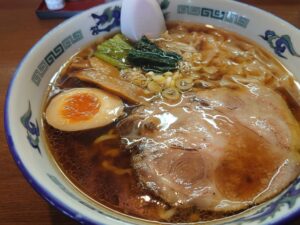
Shoyu ramen, loved by people of all ages.
Shio Ramen (Hakodate and other port towns)
Shio ramen, said to have originated in Hakodate, Hokkaidō, is marked by its clean salt seasoning and translucent broth.
Alongside pork and chicken bones, kombu kelp and dried scallops — gifts of the sea — are often used.
From the steam that rises from the bowl, one can almost sense the presence of the ocean that has long supported the life of this port town.
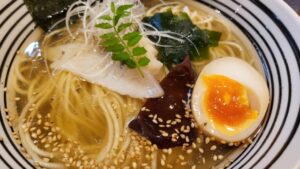
Shio ramen with a beautifully clear broth.
Miso Ramen (Sapporo)
Sapporo miso ramen is a robust, warming bowl born to carry people through Hokkaidō’s severe winters.
A broth of pork and chicken bones is enriched with miso; vegetables stir-fried in lard, corn, and butter are piled on top to complete a dish that warms the body from the core.
In this miso ramen, one feels the honest warmth of a food that exists to sustain life in the cold.
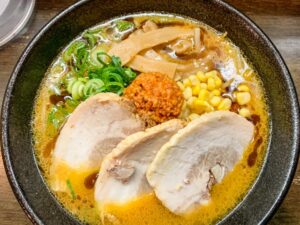
Rich miso ramen that warms you from the inside out.
Tonkotsu Ramen (Hakata and Kurume)
Tonkotsu ramen, developed in Hakata and Kurume in Fukuoka Prefecture, is known for its rich, opaque broth simmered from pork bones over many hours.
The deep, milky stock, full of extracted flavor and fat, clings to ultra-thin, low-hydration noodles.
Those fine noodles were chosen so that bowls could be served quickly to busy market workers; the custom of “kaedama,” ordering an extra portion of noodles to add to the remaining broth, grew out of the need to keep the noodles from softening as people ate.
A way of eating that balances speed with satisfaction — this carries the imprint of the lively tempo of Hakata and Kurume, where the style was refined.
Tonkotsu ramen, in other words, is a flavor that has grown in step with the daily life of its people.
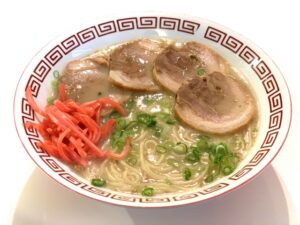
Tonkotsu ramen with a creamy white broth and thin noodles.
Each difference in a bowl is, at the same time, a difference in place.
Ramen has been shaped, in its many forms, by climate, local ingredients, and the ways of life of those who live alongside it.
Urban Density — Iekei and Jiro-Style
Ramen’s diversity was not brought forth by landscape alone.
In cities where people are constantly on the move and often pressed for time, there was a strong demand for bowls that could quickly, decisively satisfy hunger, with ample volume and intensity. At the same time, ways of serving developed that could flexibly respond to a wide range of individual preferences.
“Iekei” and “Jiro-kei” are two emblematic styles forged by these urban conditions.
Iekei Ramen (Yokohama)
Iekei ramen is built on a powerful broth that combines tonkotsu and soy sauce, paired with thick, chewy noodles.
According to one well-known account, the founder, who had worked as a long-distance truck driver and tasted ramen across Japan, arrived at this style by layering Kyushu-style pork-bone broth with the soy-sauce broths of the Kanto region.
Seasoning can be adjusted at the table, allowing customers to tailor the bowl to their own liking.
That possibility of arriving at “one’s own” flavor gave people a reason to return, again and again, to the same shop.
In this way, Iekei ramen has taken root not merely as a passing trend, but as a bowl woven into the fabric of everyday life.
Today it has grown into a major current, with Iekei shops opening all over the country.
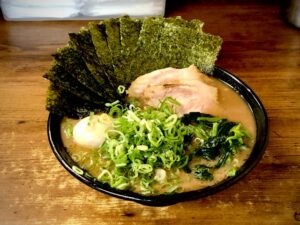
In Iekei ramen, classic toppings include nori, spinach, and chashu pork.
Jiro-Style (From Founding to Its Establishment in Mita)
Jiro-style ramen is known for its overwhelming volume: extremely thick noodles, a heavy, concentrated broth, and a mountain of vegetables.
Founded in 1968 and later relocated near Keio University’s Mita campus, it became a kind of “soul food” for generations of students.
In a district filled with young people, what was needed was not delicacy, but a bowl with enough force to push back hunger and fatigue in one go.
Moreover, Jiro-style is distinctive not only in flavor, but in how it is eaten: the particular phrases used when ordering, and the shared “rules” around the counter, have become part of its culture.
Those very practices — half ritual, half play — helped lift this ramen beyond a dish into a phenomenon.
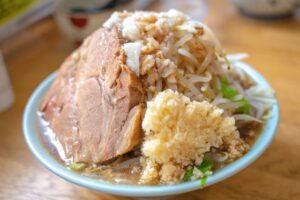
Jiro-style ramen, famed for its massive portions.
These two styles, shaped within the city, remind us that ramen is not only about taste.
It is a culture that encompasses how we eat, how we visit a shop, and how we spend time there.
A Bowl That Lives Beside Everyday Life
What, in the end, makes ramen so appealing?
Perhaps the answer lies in how unassuming its place in daily life can be.
While sushi or tempura are often spoken of as “special” foods for marked occasions, ramen is almost always within reach.
You slip into a shop in the middle of an ordinary day, and a steaming bowl quietly rescues you — such moments have long been woven, without ceremony, into everyday life.
And that familiarity cannot be explained only by “reasonable price” or “quick service.”
For people in Japan, who have eaten soba and udon for centuries, the act of slurping noodles is already part of the body’s memory.
On top of that, ramen offers an astonishing number of points of choice.
Broth style, noodle thickness and firmness, toppings, the time of day you eat, whether you go alone or with someone — all of these can be adjusted to your own preferences.
That range of options and degree of customization turns a single bowl of ramen into “my” bowl, something quietly special.
Almost everyone, surely, has at least one favorite bowl they could name.
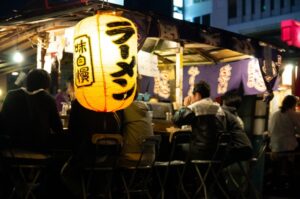
Ramen is not merely a dish.
It is an everyday landscape, born where local water and ingredients, a shop’s careful craft, and the lives of the people who eat there intersect.
That bowl you ate alone late at night.
The nameless ramen you happened upon while traveling.
The time at the counter, laughing with someone as steam rose between you.
The memory of a taste is always bound up with the scene around it.
That is why we return to ramen again and again: sometimes to discover a new flavor, sometimes to find our way back to one we once knew.
And even now, somewhere in Japan, someone is creating yet another new bowl of ramen:
kneading noodles with the water of that place, preparing broth from that region’s stock, and pouring into a single bowl a flavor that belongs only to that way of life.
Ramen continues to evolve at this very moment,
carrying as many expressions of taste as there are people who sit down to eat it.