
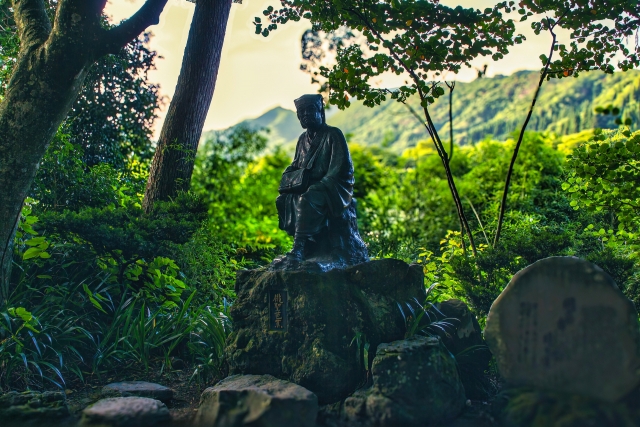
Matsuo Bashō – The Solitary Poet Who Perfected the Art of Haiku
When we hear the name Matsuo Bashō, many of us can immediately recall at least one or two of his verses.
Why is it that his haiku continue to captivate people’s hearts so powerfully, even now?
Bashō’s haiku are far more than simple poems in the fixed 5–7–5 syllabic pattern.
They are works of art in which language is pared down to the absolute limit, compressing scene and emotion into a single fleeting moment. His very soul resides in those words.
Haiku creates beauty through the act of “cutting.”
By stripping away unnecessary explanation and leaving space on the page, it invites the reader’s imagination to complete what is unsaid.
Bashō’s verses fall into the silence like a single drop of water, rippling down into the depths of the heart.
More than three hundred years later, his words still unmistakably stir our sensibilities.
A Traveler’s Solitude and Beauty
Bashō’s life was inseparable from travel.
Rather than seeking a settled home, he walked on, always in search of new landscapes.
Many of his most famous haiku were born along the road, and in them is engraved a beauty that dwells within solitude.
「夏草や兵どもが夢の跡」
Summer grasses –
all that remains
of warriors’ dreams.
This poem was written during his journey recorded in The Narrow Road to the Deep North, when he visited Hiraizumi in present-day Iwate Prefecture.
※Learn about Iwate Prefecture: Iwate Prefecture | A Timeless Landscape Woven from Nature and Tradition
Hiraizumi had once been a splendid city built by the Ōshū Fujiwara clan.
In the twelfth century it rivaled Kyoto in culture and prosperity; the Konjikidō (Golden Hall) of Chūson-ji and the Pure Land gardens of Mōtsū-ji, created as attempts to reproduce the Buddhist paradise on earth, gathered the pinnacle of the arts of the age.
Yet that glory vanished after only three generations, disappearing like a dream.
Bashō’s visit came roughly five hundred years later.
What lay before him was only a quiet landscape of summer grasses swaying in the wind.
In that scene, he must have seen the dreams and ambitions of those warriors—and the deep stillness that remained after they had crumbled.
“Summer grasses – all that remains of warriors’ dreams.”
Once a place of grand “dreams,” now thick with speechless summer grass.
The contrast brings into sharp relief the cruelty of time’s passage and the fragility of human endeavor.
In this single verse, the Buddhist sense of shogyō mujō—the impermanence of all things—is etched into the silence of the summer field.
※Shogyō mujō: the Buddhist teaching that everything in this world is in constant flux; nothing remains forever in the same state.
Bashō’s haiku are never flamboyant.
Rather, they gaze gently upon what has passed, what is disappearing, as if to cherish its transience.
That is why each of his verses lingers with a quiet depth.
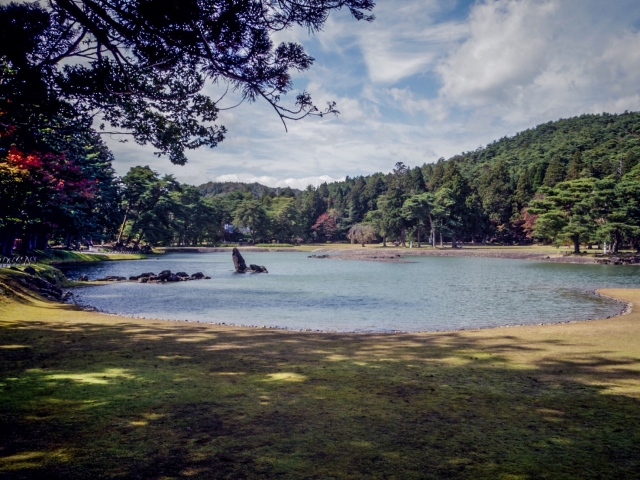
Motsu-ji, where all the original buildings are gone and only the garden remains today.
Today, Hiraizumi is inscribed on the UNESCO World Heritage List and visited by people from all over the world.
Even so, the voiceless story that dwells in the stillness of those summer grasses has surely not changed from the summer day Bashō beheld.
Sound Within Silence – A Summer Moment as Bashō Saw It
On his Narrow Road journey, Bashō also visited Yamadera (Risshaku-ji) in Yamagata Prefecture.
※Read about Yamagata: Yamagata Prefecture | A Life and Culture Woven with the Mountains
More than a thousand stone steps, halls lined along a cliff, and in the height of summer the only sound is the cry of cicadas in this sacred mountain temple.
In this tranquil space, Bashō captured a single instant that feels almost eternal:
「閑さや岩にしみ入る蝉の声」
Such stillness –
the cicadas’ cry seeps
into the rocks.
In this poem, not only the landscape but the totality of the felt experience in that place is condensed.
The opening word shizukasa ya—“such stillness”—signifies more than mere absence of noise.
It is a quiet that seems to resonate in the very depths of the heart,
the kind of silence you feel when, after climbing the long stone stairway and coming face to face with nature, even time itself seems to thin out.
In the summer air of the mountain temple, the ceaseless cries of cicadas melt into the surroundings.
The more their voices fill the air, the deeper the silence becomes.
As those cries are drawn into the stillness, they go on sounding as if “seeping into the rock” itself.
This strange sensation, in which sound and stillness become one, may be an emotion that can never be fully understood from the poem alone, but only by actually standing there.
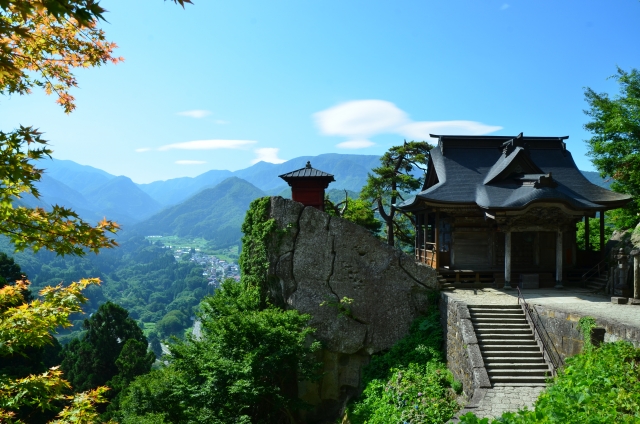
Yamadera (Risshaku-ji Temple) in Yamagata Prefecture.
On a certain summer day, the author of this essay also visited Yamadera.
Amid the deep green of the mountains and the moss-covered steps, layers of cicada song could be heard from far and near.
Then, in the moment one stopped walking, it felt as if all other sounds were absorbed away, leaving only the cicadas’ voices, truly seeping into the rock.
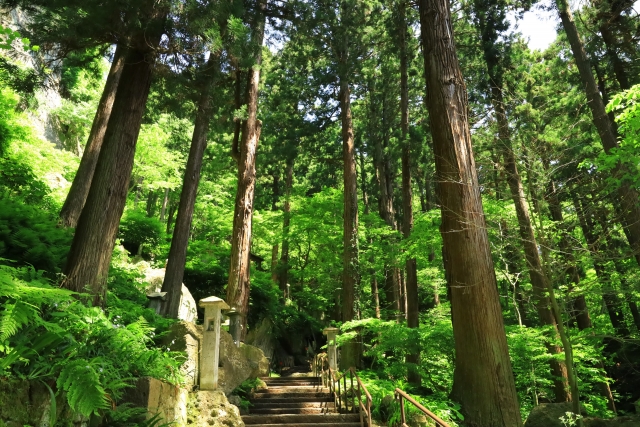
The mountain path at Risshaku-ji, where Bashō composed his haiku.
On a hot summer day, the cicadas’ chorus filling the world draws silence into the landscape rather than dispelling it.
Bashō’s brilliance lies in capturing that entire scene and feeling in the single phrase “seeping into the rocks.”
Without piling up explanation, he pulls us straight into that place.
The strength of that one expression is what makes the poem unforgettable.
The Eternal Beauty Within Fueki Ryūkō
As he deepened his pursuit of haikai, Bashō articulated a poetics known as fueki ryūkō.
Fueki refers to what does not change—the underlying essence.
The changing seasons, the beauty of nature, the delicate stirrings of the human heart: the core elements that remain unshaken, no matter how times change.
Ryūkō, by contrast, refers to what flows with the age: the newness that shifts alongside the times, the creative force that is unafraid of change and constantly gives rise to fresh expression.
One of Bashō’s sayings is often quoted:
Fueki o shirazareba moto tachi-gataku,
ryūkō o shirazareba kaze arata-narazu.
If you do not know what is unchanging, you cannot lay a true foundation.
If you do not know what is of the moment, your style can never be renewed.
Bashō’s haiku stand precisely on the balance between these two poles—fueki and ryūkō.
What he sought was not showiness that merely pandered to fashion,
but an “eternal beauty” that remains within things that change.
For that, he kept traveling, facing the natural world and honing his words.
Fueki ryūkō is no mere slogan.
It was the principle that supported Bashō’s way of life, and it continues even now to breathe at the heart of haiku.
Why Do Bashō’s Haiku Resonate With Us?
Why is it that Bashō’s haiku, after three centuries, still reach so many hearts?
Because his words grasp “universal truths” that speak across time and borders.
The beauty of nature, the transience of life, a fleeting presence felt within silence—
these are things that remain irreplaceable to us who live today.
In an age saturated with information and overflowing with language,
Bashō’s “seventeen syllables of stillness” may be precisely what quietly restores our inner balance.
Each time we read his haiku, they reveal a new landscape.
They are not mere explanations, but invitations to sharpen our sensibility—
to ask, “How do you see the world?”
Haiku reflects what cannot be seen, and lets us feel sounds that cannot be heard—it is poetry brought to its utmost limit.
The words Matsuo Bashō left behind, one by one, are like quietly burning flames.
Even now, they continue to gently warm our hearts.
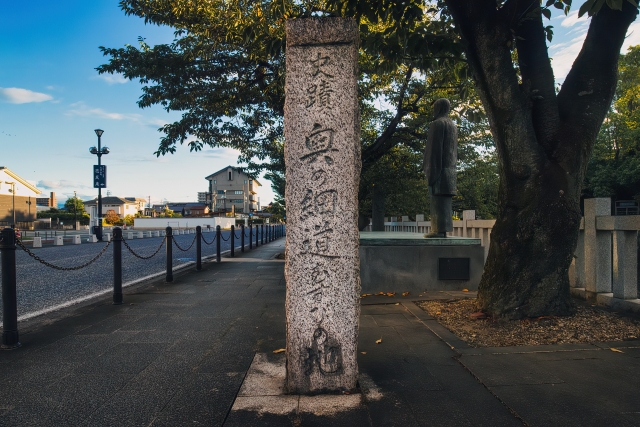
Monument marking the ending point of Oku no Hosomichi in Ōgaki, Gifu Prefecture.