
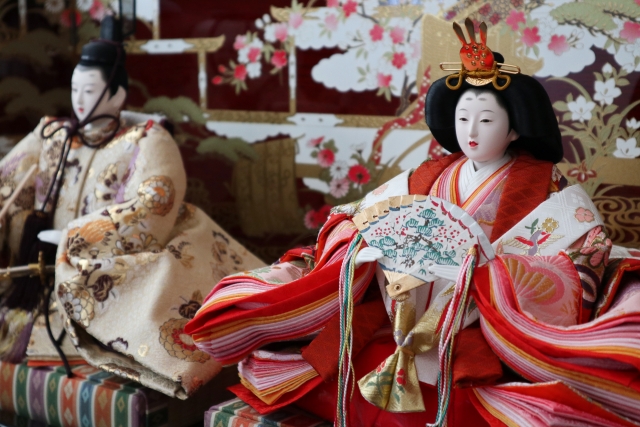
Hinamatsuri
— The Wishes Entrusted to the Hina Dolls
As March approaches, dolls begin to appear inside Japanese homes.
They are widely known as part of a seasonal celebration that announces the arrival of spring and expresses prayers for the healthy growth of children.
But what were these dolls originally created for?
To understand the answer, we must first trace what the “human form” has meant in Japan.
Through the hina dolls, this article explores what faith is for a people who have long entrusted their prayers to human-shaped objects.
What Dwells in the Human Form
In Japan, there has long existed the idea of yaoyorozu no kami—the belief that countless deities dwell in all things.
Mountains, rivers, wind, and stones are all understood as capable of housing the sacred. The divine is not confined to a distant realm; it is believed to reside in things close at hand.
Within this worldview, objects are often perceived as something that can contain more than their material presence.
What dwells in them is not limited to gods or souls.
Human thoughts, emotions, and even misfortune may be placed within them.
Among such objects, those shaped in the human form are received as something special.
A representation of a human figure cannot be treated as a mere object.
Just as mountains and wind can serve as vessels for the sacred, a human-shaped object can become a vessel for a specific person—something that may stand in for them.
This is why dolls are given memorial rites when they are discarded in Japan.
In traditional straw-doll curses as well, the human-shaped figure is treated as a substitute for a particular individual.
From Substitute Figures to Hina Dolls
Dolls That Take On Impurity and Misfortune
Since ancient times, Japan has held the idea that calamity and impurity can be transferred to something else and thereby removed.
The Hadaka Matsuri (Naked Festivals) that still takes place today is an extension of this way of thinking.
In this ritual, the nearly naked body itself becomes a vessel that receives misfortune, as participants step forward before the deity.
With nothing but their bodies, they take upon themselves the impurity and misfortune of the community and entrust it to the divine through prayer.
This role, when given not to a person but to a human-shaped object, becomes the katashiro.
A katashiro is a substitute figure made of paper or wood in the shape of a human.
In the Shinto tradition there is misogi, the act of purifying body and mind by immersing oneself in river or sea water.
One of its practices is to transfer one’s impurity to a katashiro and let it flow away in water.
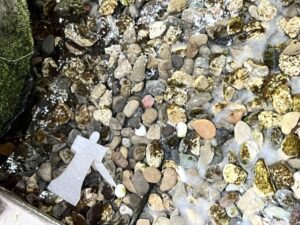
The custom of transferring impurities to human-shaped paper and letting them float away on water continues today.
This is the most direct example of how a human-shaped object is used as a substitute for a person.
This act of entrusting impurity to a katashiro and sending it away in water still survives in various forms throughout Japan today.
The Beginning of Nagashi-bina
The practice of transferring impurity to a katashiro and setting it adrift gradually came to be linked with the seasonal turning point of the third month.
March 3rd derives from the Jōshi no sekku, a seasonal observance that originated in China.
Around this time of year in the old lunar calendar, the change of seasons was thought to be a moment when impurity and misfortune were more likely to arise. People would go to the waterside, purify themselves, and wash away defilement through ritual ablution.
When this custom reached Japan, it merged with the existing practice of misogi. Instead of cleansing the body directly in water, impurity was transferred to a human-shaped figure and set afloat.
This became the custom later known as nagashi-bina.
Small paper dolls were given the misfortune of a child and sent down rivers or out to sea in prayers for their healthy growth.
In this way, the substitute figure came to be tied to a seasonal observance, and a ritual act of purification took on the form of an annual event.
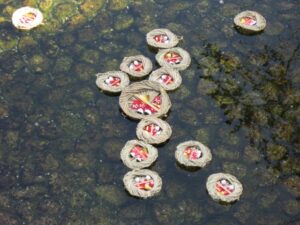
流しびな
The Fusion with Hina Play
Around the same time that nagashi-bina became established as a seasonal observance, a form of doll play known as hina-asobi spread among the children of the aristocracy.
“Hina” originally meant small and charming dolls.
Children placed these miniature human figures before them, arranged furnishings, and reenacted scenes of everyday life.
On the one hand were dolls that received misfortune and were set adrift in water; on the other were dolls that remained close at hand and were cherished.
These two different kinds of dolls came to merge within the same cultural sphere.
The doll that carried misfortune away from the body came to be placed beside the child as a protective presence.
In this way, the role of the doll was transformed.
This was the beginning of the hina doll.
Faith Within Everyday Life
As discussed in the article “Are the Japanese Non-Religious?”, the Japanese have long allowed their prayers and wishes to blend naturally into everyday life.
Hina dolls, too, are closer to a daily custom than to a formal religious ritual.
Although their origins lie in the Shinto practice of misogi, their religious meaning is not brought to the surface. They continue quietly as a seasonal observance.
Faith is not limited to the moment one visits a shrine and folds one’s hands in prayer.
It lives within the repetition of everyday customs, annual events, and inherited practices.
This is one form of the Japanese religious outlook.