
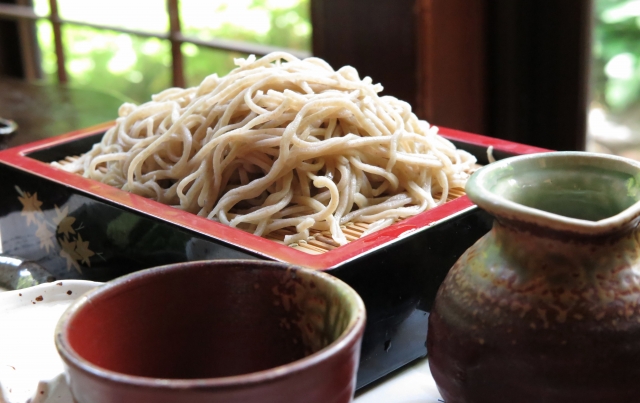
The Japanese and Soba
Japan has many kinds of noodles—udon, ramen, sōmen, kishimen, to name just a few.
Among them, soba holds a slightly special place.
On one hand, it stands at the very front line of everyday practicality, as with stand-and-eat soba shops at stations.
On the other, behind the curtains of long-established restaurants, people speak with care about the aroma of the flour, the way the dough is worked, and the character of the broth.
It is both utterly familiar and quietly dignified.
Soba is also a dish in which climate, methods of preservation, and the daily rhythms of life are all condensed.
In what follows, by tracing how soba has taken root in Japanese life and looking at regional soba cultures, we will try to shed light on the ways Japanese people live.
The History of Soba in Japan
Soba was originally treated as a famine-relief crop—a grain cultivated as a safeguard against years of poor harvest.
In a country of many mountains and limited arable land, rice remained the main staple, but there were always areas unsuitable for rice cultivation and the constant need to prepare for bad weather and crop failures.
Because soba grows even in cold and harsh conditions, it was accepted in many regions as a kind of “insurance” against hard times.
Court records mention recommendations to plant wheat and soba in preparation for drought, suggesting that from an early period soba was recognized as a food that supported everyday life.
From Crop to Dish
In records from the Heian period, soba appears under names such as sobamugi.
However, this “soba” was not the noodle dish that comes to mind today.
In an age when people built their diet around rice while combining it with various other grains, soba, too, was most naturally understood as something that supplemented the staple food.
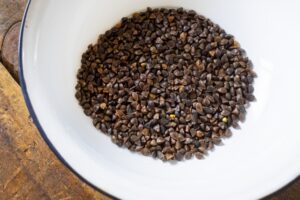
Buckwheat grains, which in the Heian period served as a supplementary food alongside other staple grains.
It was only much later that soba began to take shape as a flour-based preparation and eventually evolved into noodles.
The Spread of Flour-Based Foods
Soba, which had primarily been treated as a “crop,” began to make its way more deeply into daily life as the idea of grinding it into flour and using it that way spread.
Flour keeps well and its quantity can be adjusted easily.
Because it can be used in just the amount needed, when needed, soba began to move from being an “emergency” food to something for everyday meals.
The accumulated practice of “kneading flour into something to eat” is what lifted soba from the status of a mere crop into that of a cooked dish.
The Emergence of *Soba-kiri*
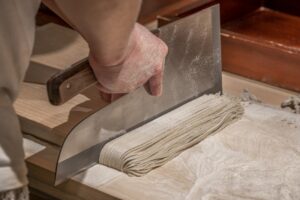
The advent of soba-kiri marked buckwheat’s shift from crop to cuisine.
Soba takes on a clear identity as a noodle in the form known as soba-kiri.
The soba flour is brought together into a dough, rolled out thin, cut into fine strands, and then boiled briefly.
Through these steps, soba is transformed into a dish with a defined set of procedures.
By the latter half of the sixteenth century, there are records of soba-kiri being served on celebratory occasions, indicating that soba had expanded its role from a supplemental everyday food to a dish used to entertain guests.
The appearance of soba-kiri was a major turning point, marking soba’s shift from “crop” to “cooked cuisine.”
Soba Spreads in Edo
Once soba-kiri had taken shape, soba spread rapidly through the city of Edo.
In an urban environment where large numbers of people gathered and where there was a constant need to eat quickly between bouts of work, soba—“cut, boiled, and served at once”—made perfect sense.
Yet soba never remained just a “quick bite.”
By carefully preparing the broth and establishing their own house style, shops created clear differences in flavor from the same basic dish, and reputations naturally formed.
Because soba could be served quickly yet still showed marked variations in taste, it rose to become a staple of city life.
Thus in Edo, soba became both an everyday food and something about which each shop’s approach and pride could be discussed.
Its dual character—both close at hand and quietly formal—was laid down in this period.
Soba Today – Changing Forms, Enduring Roles
Having been firmly established in Edo as a “city staple,” soba has, in modern times, entered everyday life in an even greater variety of forms.
Stand-and-eat soba shops support people’s tightly scheduled days.
Chain restaurants provide stable flavors at accessible prices.
Specialist shops place value on the origin of the buckwheat, the way it is milled, and the skills used in making the noodles.
At home, dried and frozen soba have become commonplace, and soba has expanded its territory from something “eaten out” to something “eaten at home” as well.
At the same time, some things have not changed.
As seen in customs like toshikoshi soba on New Year’s Eve and hikkoshi soba given at moving house, soba remains indispensable as a food associated with good fortune.
Into each bowl are folded wishes—for life and family to continue “slender yet long,” and for misfortune to be cleanly cut off.
Soba Across Japan – How Famous Bowls Reflect Their Homelands
Even though we call them all “soba,” the character of the noodles changes strikingly from region to region.
The way the aroma opens up, the feel on the teeth—these and more are shaped by climate, water, milling methods, and other conditions.
Beyond that, local ways of life have influenced everything down to the “style” of presentation and how the noodles are eaten.
Here, we will look at some of Japan’s best-known soba, focusing on the “three great soba” (Togakushi soba, Izumo soba, and wanko soba) as a starting point.
Togakushi Soba (Nagano Prefecture)
Togakushi soba, nurtured in the Togakushi region of Nagano Prefecture, is known as one of Japan’s three great soba.
The cool climate and water conditions of this highland area directly shape its aroma and texture, making it a celebrated soba.
Soba grown in mist-prone environments is said to develop a stronger fragrance, and the step of rinsing the freshly boiled noodles in cold water gives them a clean, refreshing feel as they go down.
The distinctive serving style known as bocchi-mori, in which small bundles of noodles are neatly arranged together, has also taken root as part of the Togakushi way.
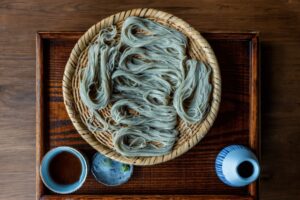
Togakushi soba arranged in small, bite-sized bundles (bocchi-mori style).
Izumo Soba (Shimane Prefecture)
Izumo soba, representing the Izumo region of Shimane Prefecture, is likewise counted among Japan’s three great soba.
Its defining feature is the use of hikigurumi flour, milled from the buckwheat grains together with their outer layers.
This gives the noodles a darker color and firmer bite, and by grinding the whole grain, the soba’s aroma comes forward strongly.
The style of eating known as wariko soba also shows how soba has taken root as an everyday food in Izumo.
Wariko soba is served in small round lacquer bowls stacked two or three high.
Diners add condiments and pour broth over the noodles in each bowl as they eat their way down the stack—a way of using what is at hand to enjoy soba all the way to the last bite.
In a prefecture of many mountains and cold winters like Shimane, conditions are well suited for growing soba.
Within that natural environment, soba with the robust fragrance of hikigurumi flour and the custom of wariko service have come together to form the taste of Izumo.

Wariko soba, buckwheat noodles served in stacked round bowls—the classic way to enjoy Izumo soba.
Wanko Soba (Around Morioka, Hanamaki, and Ichinoseki in Iwate Prefecture)
Wanko soba, known in and around Morioka, Hanamaki, and Ichinoseki in Iwate Prefecture, stands out not only for the noodles themselves but also for its distinctive style of hospitality.
Small servings are placed in individual bowls and brought out one after another so that guests can always eat the noodles freshly boiled.
What began as a practical way to ensure that visitors could enjoy soba piping hot has, over time, solidified into a defining feature of the region.

In wanko soba, the etiquette of hospitality itself has become a tradition.
The cool climate and excellent water form the foundation for soba making, and on top of that has been layered a spirit of caring for guests.
Together, these have polished wanko soba into the unique format we know today.
Hegi Soba (Around Tōkamachi and the Uonuma Region in Niigata Prefecture)
Hegi soba is a beloved local soba in and around Tōkamachi City and the Uonuma region of Niigata Prefecture—a famous noodle born of snow-country life.
Its hallmark is the use of funori (a type of seaweed) as a binding agent.
When the noodles are tightened in cold water, they take on a distinctive firmness and a smooth, silky feel as they slide down the throat.
The serving style—neatly arranging bite-sized portions in a wooden tray called a hegi—is not only visually refined but also practical, making it easy to eat and share.
In this land of deep snow and harsh winters, people have polished the “form” of hegi soba by making the most of the ingredients and workflows available to them.
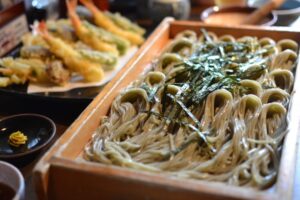
Hegi soba, served in small, neatly arranged portions on a tray called a hegi.
Sarashina Soba (Tokyo / Edo)
Sarashina soba is a type of soba refined in the city of Edo.
Rather than being shaped by natural landscape, it is a famous noodle born from urban tastes and artisan skill.
Because it uses flour taken from near the center of the buckwheat grain, the noodles are pale in color and relatively mild in aroma.
In exchange, they offer an elegant feel as they go down and a subtle sweetness that comes to the fore.
In Edo’s soba shops, the strength of the broth, the way the stock was drawn, and the exact boiling time all translated directly into differences in flavor.
Within this competitive environment, sarashina soba, with its whiteness and smooth texture, answered to an urban palate that prized refinement.
Rather than relying on a strong aroma, it established itself as Edo-style soba by succeeding through lightness and grace.
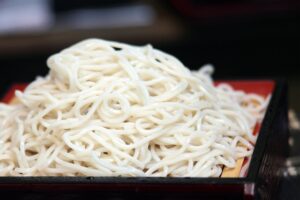
Sarashina soba, known for its pale color and delicate texture.
Soba is indispensable when talking about Japan’s noodle culture.
Depending on the cold of the climate, the quality of the water, how the flour is handled, and the way people live, the aroma, texture, and even the way soba is eaten all change.
Togakushi, Izumo, Iwate, the hegi soba of the snow country, Edo’s sarashina—each bowl that has earned a reputation as “famous soba” is a clear expression of those differences.
The next time you eat soba, try recalling, just for a moment, where it comes from and the background of how it is served.
You may find that your usual bowl feels just a little different.