
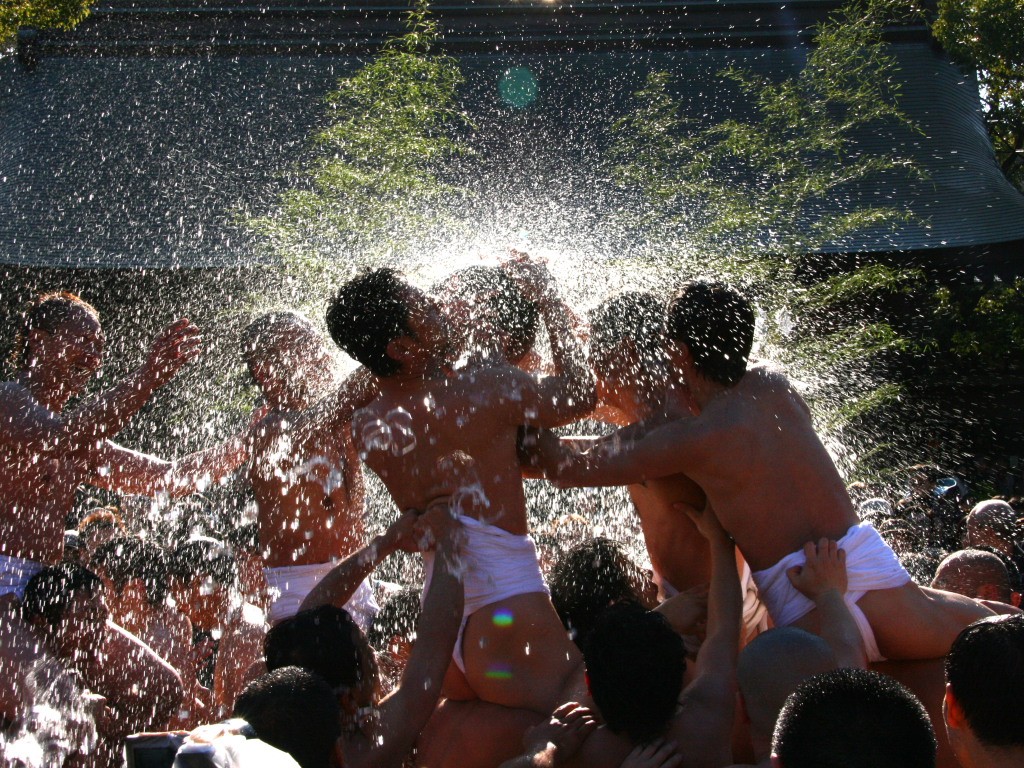
Stillness and fervor. Entering the sacred grounds in a state of purity, stripped of all worldly adornments.
Festivals are an essential part of Japanese culture.
Across the country, through every season, countless celebrations take place. Among them, one stands apart for its striking intensity: the Naked Festival.
As the name suggests, participants take part in sacred rituals wearing little more than a loincloth.
And many of these festivals are held in the depths of winter.
Why, in Japan, do people stand before the divine in such a state?
At the heart of this lies an old belief—one rooted in purification and the removal of impurity.
What is a Naked Festival?
Why do people choose to face the divine with nothing but their bare bodies?
Behind it is a way of faith that has been carried through generations in Japan.
Why Do Participants Become Naked?
A Naked Festival is a ritual in which people strip away all coverings, purify themselves, and stand before the divine in a cleansed state.
Nakedness as Purity
In Shinto, there is a practice known as misogi, in which the body is immersed in rivers or the sea to cleanse both body and spirit.
It is an act of washing away impurity before approaching the divine.
The same idea appears in Naked Festivals.
Participants often purify themselves with cold water before the ritual begins.
Becoming naked is not an act meant to shock or attract attention.
It is a way of casting off everything unnecessary and stepping forward in the most unadorned state possible.
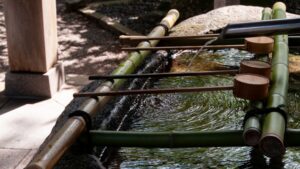
Misogi: The primordial ritual of purification by water, washing away the impurities of daily life.
Taking on Misfortune
Naked Festivals also reflect another belief—the idea of taking on misfortune in place of others.
In Japan, there has long been a practice of transferring impurity onto something else and removing it.
For example, hitogata—paper figures shaped like the human body—are used to carry away defilement and are then set adrift in water.
In these festivals, the human body itself can take on that role.
Participants step forward, symbolically carrying the misfortune of their community, and entrust it to the divine.
This is one of the ideas that sustains the tradition.
Why Winter?
Many Naked Festivals take place in January and February, in the coldest part of the year.
This is not because the cold itself is important.
In Japan, there has long been a tradition of purifying oneself before welcoming the new year.
The year-end Ōharae and Setsubun, observed on the eve of the beginning of spring (Risshun), are examples of this.
Naked Festivals belong to this same current.
They are held in winter not because of the season itself, but because it is a time set aside for renewal.
Representative Naked Festivals Across Japan
Naked Festivals across Japan differ in form, but each reflects a distinct local expression of belief.
Here are three well-known examples, often referred to as Japan’s “Three Great Naked Festivals.”
① Saidaiji Eyo (Okayama) — A Night Struggle for Fortune
Held at Saidaiji Kannon-in Temple in Okayama City, this festival dates back more than 500 years to the Muromachi period.
On a February night, the temple grounds fill with men in white fundoshi.
After purifying themselves with cold water, they rush into the main hall.
At around 10 p.m., two sacred wooden sticks (shingi) are thrown into the darkness.
In the dim interior, a fierce struggle begins.
The man who secures them is called the Fuku-otoko—the one who receives fortune for the year.
It may look like a contest of strength.
But beneath it lies a shared intention: to purify, to cast off misfortune, and to receive blessing.
②Konomiy Naked Festival (Aichi) — Entrusting Misfortune to One Man
At Owari Ōkunitama Shrine in Aichi, this festival centers on a single figure: the Shin-otoko, or Sacred Man.
Each year, one man is chosen and undergoes a period of purification before the festival.
People reach out to touch him, transferring their misfortune and praying for health and safety.
In doing so, he becomes the one who carries it.
Here, misfortune is gathered, entrusted to a single body, and offered to the divine.
③ Hakozaki Shrine “Tamaseseri” (Fukuoka) — Contesting a Sacred Ball
Held on January 3 in Fukuoka, this festival revolves around a wooden ball roughly 28 cm in diameter and weighing about 8 kg.
Men known as the Tama-tori-shū compete to claim it.
The ball represents a sacred jewel believed to bring prosperity—whether in harvest or business—to the side that obtains it.
After purifying themselves with cold water, participants divide into two teams and struggle to bring the ball to their side.
Even here, beneath the intensity, the purpose is clear: to draw in fortune and pray for the year ahead.
What Naked Festivals Reveal About Japanese Faith
Today, many Naked Festivals face challenges—aging communities, fewer participants, safety concerns, and changing attitudes toward nudity.
Some have come to an end.
Others continue by adapting their form.
Yet the essence remains unchanged.
To purify.
To pray for the year ahead.
To gather and share that intention with others.
This is what defines the Naked Festival.
At first glance, it may seem unusual.
Yet behind them lies the sincere attitude of the Japanese people, who seek to purify themselves and face the divine.

