Joya no Kane – The Bell that Marks an Ending and a Beginning
On New Year’s Eve in Japan, if you listen closely as the night deepens, you may hear the low, resonant sound of a temple bell somewhere in the distance.
Its tone spreads slowly through the cold air, quietly signaling the end of the year while at the same time hinting at the new year that is about to begin.
This bell, which rings out across the land at year’s end, is known in Japan as “Joya no Kane”—the New Year’s Eve bell.
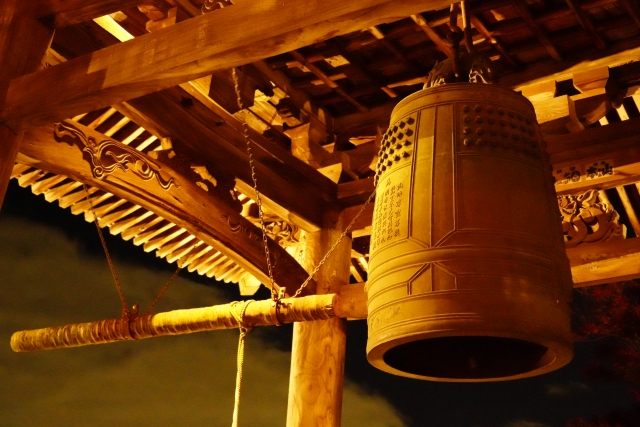
Joya no Kane refers to the ringing of large Buddhist temple bells (bonshō) across Japan from the night of December 31 through around midnight on New Year’s Day.
It is a Buddhist observance that has long been passed down as a time to look back on the year gone by, let go of what has accumulated in the heart, and prepare oneself to welcome a new year.
The Origins of Joya no Kane
The origins of Joya no Kane are believed to go back to the Song dynasty in China.
Originally, temple bells were struck on the last night of each month in a rite meant to drive away evil influences. Over time, this custom came to be concentrated on the night of the year’s end, New Year’s Eve.
It is thought that this practice reached Japan during the Kamakura period and spread to temples around the country, especially those of the Zen temples.
By the Edo period, temple bells had become firmly rooted in people’s lives—particularly in urban areas—as the familiar “sound of seeing in the New Year.”
Later, in the Shōwa era, radio and television began broadcasting live coverage of New Year’s Eve, and the sound of Joya no Kane became widely shared as one of Japan’s quintessential year-end scenes.
Whether heard in a quiet temple precinct or faintly through a window at home, the tolling of the bell on New Year’s Eve has, over a long span of time, come to embody the very image of a Japanese New Year’s transition.
Why the Bell Is Struck 108 Times
At many temples, the New Year’s Eve bell is struck exactly 108 times.
Several explanations exist for this number, but the most widely known is that it represents the “number of human bonnō”—earthly desires or delusions.
In Buddhist thought,
each of the six senses—
eye, ear, nose, tongue, body, and mind—
is associated with three basic reactions:
liking, disliking, and indifference (6 × 3 = 18).
Each of these is further divided into a
“pure” and a “defiled” state (18 × 2 = 36).
These in turn are considered across the three dimensions of time:
past, present, and future (36 × 3 = 108).
In this way, the number 108 has come to symbolize the many mental movements that trouble the human heart.

It is said that humans have 108 earthly desires.
Other explanations also exist—for example, that combining the numbers in the expressions shiku-hakku (“four sufferings, eight sufferings” – 4 × 9 and 8 × 9) yields 108, or that it corresponds to the total of various calendrical divisions used to mark out a year.
With each toll of the bell, one lets go of a portion of the attachment and confusion that piled up over the year.
In Joya no Kane there is a wish: to cast off these burdens one by one and greet the new year with a refreshed heart.
Bells That Carry the New Year Across Japan
Joya no Kane is observed at temples throughout Japan, but some are particularly well known.
Below are a few representative temples whose bells have become deeply associated with the image of New Year’s Eve.
Chion-in (Kyoto City, Kyoto Prefecture)
The great bell of Chion-in, the head temple of the Jōdo (Pure Land) school, is one of the largest in Japan, standing about 3.3 meters tall and weighing roughly 70 tons.
On New Year’s Eve, seventeen monks coordinate their movements to pull on the ropes and strike the bell, a scene that has long been broadcast on television and recognized nationwide as a symbol of year-end.
Both the imposing sight and the bell’s massive, reverberating tone have come to epitomize Kyoto’s New Year’s Eve.
【New Year’s Eve bell at Chion-in, the head temple of the Jodo sect.】
Tōdai-ji (Nara City, Nara Prefecture)
At Tōdai-ji, the head temple of the Kegon school and home of the Great Buddha of Nara, the New Year’s Eve bell is also struck in the presence of many worshippers.
Its great bell, approximately 2.7 meters in both height and diameter, is counted among the “three famous bells of Japan” and is considered a representative example of Nara-period style.
The deep, heavy sound that slowly spreads through the winter air of the ancient capital, together with the vast temple complex, lends an even more solemn atmosphere to the moment of seeing in the New Year.
【New Year’s Eve bell at Todai-ji Temple.】
Eihei-ji (Eiheiji Town, Fukui Prefecture)
Eihei-ji, the head temple of the Sōtō Zen school, is known as a rigorous training monastery.
On New Year’s Eve, the temple’s training monks take turns striking the bell.
In the snow-covered mountain precincts, surrounded by tall cedars, the sight of many monks, one after another, stepping up to ring the bell is steeped in a tense, austere atmosphere.
At another bell within the grounds, ordinary visitors may also take part, making it a cherished event in which people can experience New Year’s Eve in the unique environment of a Zen training temple.
【New Year’s Eve bell at Eihei-ji Temple.】
At each temple, the size of the bell, the way it is struck, and the expressions of those who gather there all differ slightly.
Yet the sound that rings out into the night sky on New Year’s Eve is, at its core, much the same everywhere—and it has quietly accumulated in people’s memories as the sound of “New Year’s transition.”
A night listening to the sound of temple bells.
On New Year’s Eve, if you pause for a moment—
in the stillness of a temple courtyard, or by your window at home—and listen carefully,
you may hear the slow tolling of a bell from far away.
Joya no Kane is, on one level, a Buddhist rite meant to dispel earthly desires.
At the same time, it is the sound that gently announces that ending and beginning have overlapped in a single moment.
Listening to the bell, we look back on the year that has passed and let our hopes turn toward the year to come.
This modest interval of reflection will, in one form or another, continue to be handed down as a defining scene of Japan’s year-end for many years into the future.