
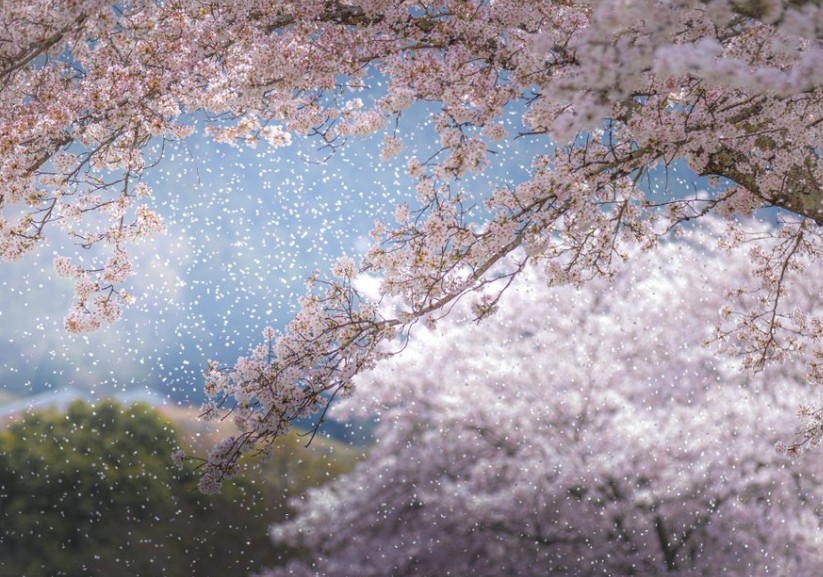
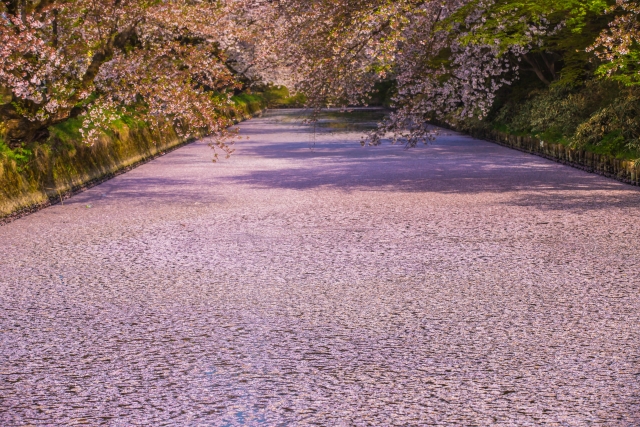
Hana-ikada, or “flower rafts,” gently tinting the water’s surface. These drifting petals remind us of the beauty of “Mujo” (Impermanence)—the truth that nothing stays the same forever.
With the arrival of spring, cherry blossoms tint the Japanese archipelago in a soft shade of pink.
Their brilliance naturally draws people to a stop.
Full-bloom cherry blossoms are “beautiful.”
And yet, it is at the moment they begin to fall that we find ourselves most deeply moved.
Petals drift to the ground, flow along the surface of rivers, and scatter on the wind.
In that fleeting sight, there is a quiet mixture of poignancy, stillness, and a certain kind of grace.
Why is it that Japanese people are so deeply moved by this transient image of cherry blossoms?
Behind this feeling lies a way of thinking that has long supported the foundations of Japanese culture.
That is the idea of impermanence.
Impermanence, rooted in the Buddhist concept of
shogyō mujō—the understanding that all things are in constant flux and nothing remains unchanged—
finds meaning and beauty within that very transience.
What Is Impermanence?
The Idea of Shogyō Mujō
Shogyō mujō is one of the core teachings of Buddhism.
The more we believe that what changes should remain unchanged, and the more we cling to it, the more we suffer.
Thus, it teaches that we must accept change.
In Japan, this idea of impermanence did not remain a mere doctrine but took root as an aesthetic sensibility—one that finds beauty within transience.
Rather than grieving the end, it turns its gaze toward the brilliance of a moment precisely because it will end.
From this, a uniquely Japanese sense of beauty emerged.
How Impermanence Became an Aesthetic
The concept of impermanence itself did not originate in Japan.
It was introduced through Buddhism as a teaching meant to release attachment.
Yet in Japan, it took root within climate and daily life, gradually shaping a way of seeing.
In a land where the seasons change distinctly, the landscape is in constant transformation.
Flowers bloom and eventually fall; mountains change color and return again to quiet stillness.
The seasons come around again, but no single moment ever returns.
Within this repetition, impermanence came to be understood not as an abstract idea, but as something present in everyday scenery.
Because there is an end, the present becomes irreplaceable.
Through this accumulation of moments, transience itself came to be perceived as beauty.
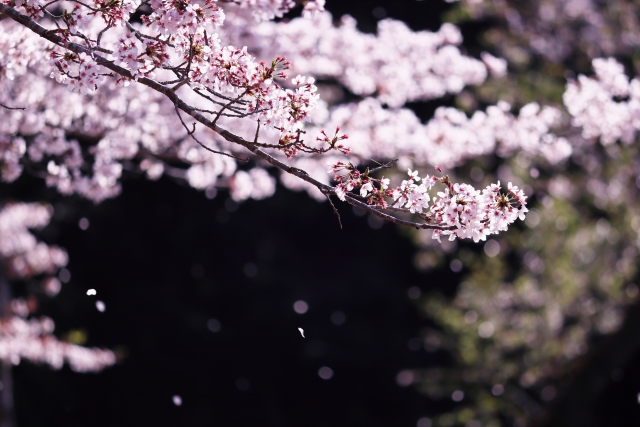
The very moment they leave the branch. In that fleeting brilliance of constant change, Japanese people found the profound truth of “Mujo” (Impermanence).
The Aesthetics of the Moment of Falling
The beauty of falling cherry blossoms cannot be explained by impermanence alone.
It also reflects a Japanese sensitivity toward how things end.
Impermanence recognizes that all things change.
But the aesthetics of the falling moment focus not on change itself, but on how something comes to an end.
In the way cherry blossoms fall without hesitation, we perceive a kind of grace.
After reaching their peak in full bloom, they scatter all at once in the wind.
There is no clinging, no excess—only a quiet, unburdened ending.
If impermanence is a way of understanding that change is inevitable,
then this aesthetic asks how one meets that moment of change.
Knowing that change cannot be avoided, it places value on how one accepts the end.
Cherry blossoms, at their most radiant, release themselves without hesitation.
If impermanence is a way of seeing the world,
then this grace becomes a way of living.
Cherry blossoms embody both.
Impermanence in Literature and History
The reason impermanence came to be understood as a form of beauty is deeply connected to literature.
In Japan, people did not simply mourn the changing world; they gave it form through words and preserved it.
Impermanence in The Tale of the Heike
The Tale of the Heike is one of the works that most powerfully expresses impermanence in Japanese literature.
The sound of the bells of Gion Shōja echoes the impermanence of all things.
The color of the flowers reveals the truth that the prosperous must decline.
As expressed in this famous opening passage, prosperity and power never last forever.
By depicting the rise and fall of the Taira clan, the work presents impermanence not as an abstract idea, but as something that unfolds within lived reality.
It reveals that human existence itself is part of this constant flow of change.
Impermanence in Poetry and Cherry Blossoms
In the world of classical Japanese poetry (waka), cherry blossoms have long been a symbol of impermanence.
In The Tales of Ise, a poetic narrative from the Heian period,
there is a well-known exchange concerning cherry blossoms.
If there were no cherry blossoms in this world,
how peaceful our hearts would be in spring.
To this poem by Ariwara no Narihira, Ki no Aritsune responds:
It is precisely because they fall that cherry blossoms are more beautiful.
In this fleeting world, nothing lasts forever.
Cherry blossoms bloom again this year, and once more, they fall.
What do we see in that sight?
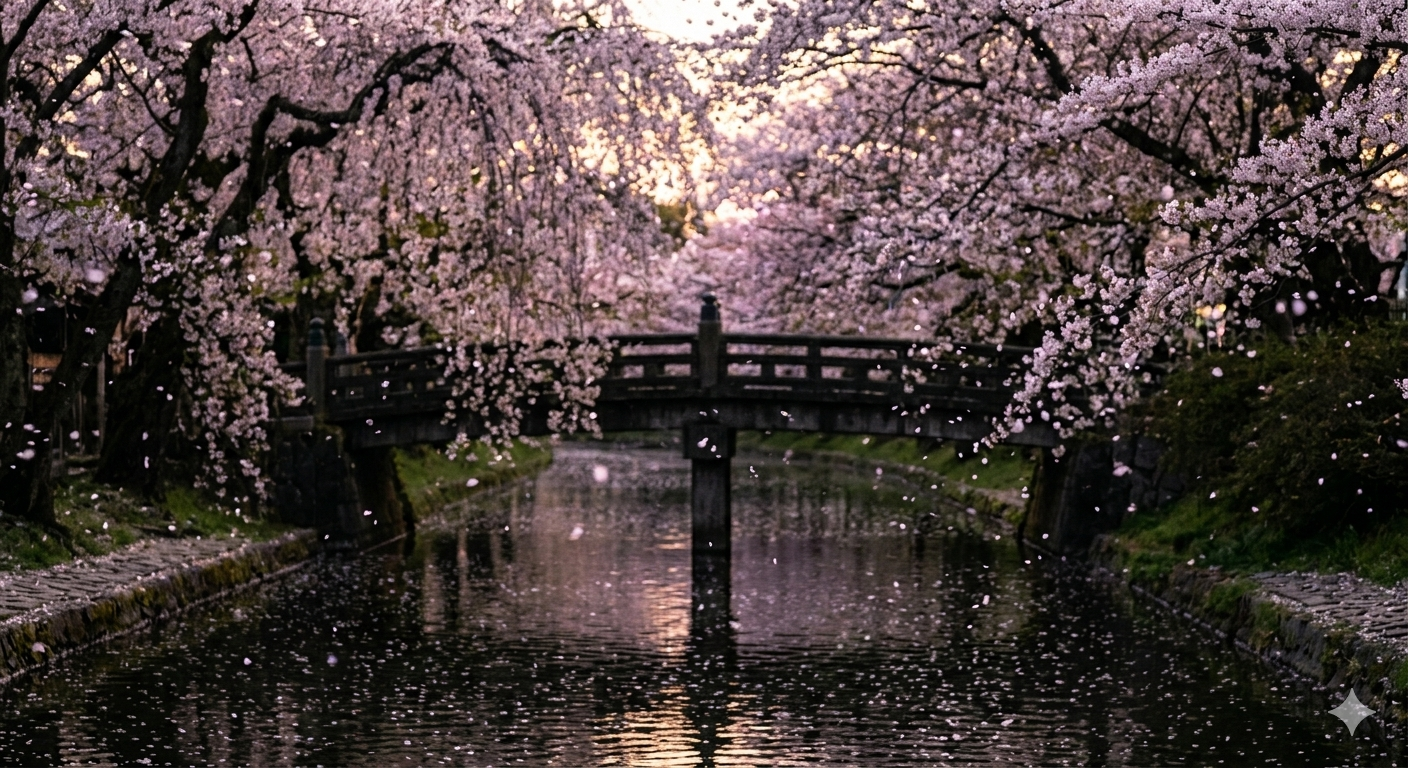
A fleeting scattered of petals faintly coloring the water beneath the dusk light. Japanese people have found an endless sense of “Mujo” (Impermanence) in this timeless scene since the Heian period.
Impermanence in Tsurezuregusa and Hōjōki
There are also reflective writings that look closely at the transience of life, such as Tsurezuregusa and Hōjōki.
In Hōjōki, events such as great fires that destroyed the capital, earthquakes, and famines are recorded.
In the face of forces beyond human control, the routines of daily life are easily swept away.
In Tsurezuregusa, the changing nature of human life and the unpredictability of everyday events are described in a calm, understated tone.
Prosperity and decline, encounters and partings—none remain in the same form forever.
Cherry Blossoms and the Aesthetics of the Samurai
Cherry blossoms eventually came to be seen as reflecting the way of the samurai.
As expressed in the saying, “Among flowers, the cherry blossom; among men, the warrior,”
they came to embody an ideal way of living.
What was expected of a samurai was not a long life,
but a life lived with resolve.
To devote oneself to one’s lord or cause,
and to withdraw without lingering attachment—this was valued.
Cherry blossoms, after reaching their peak, fall without hesitation.
They do not cling to the branch until they wither away.
In that image, one can see the beauty of knowing when to let go.
What the samurai saw in the cherry blossom was not simply “falling,”
but the ability to step away at the right moment, with dignity.
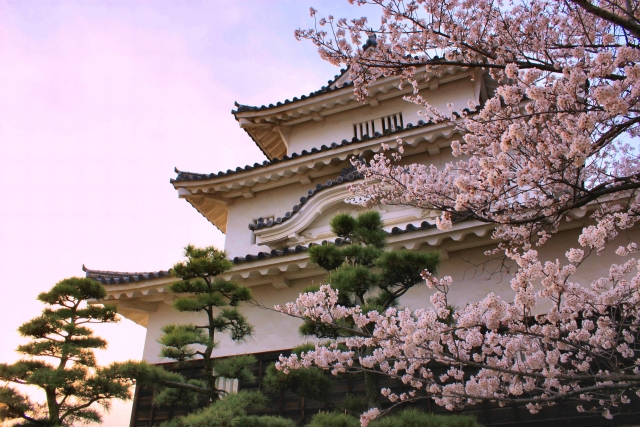
“Among flowers, the cherry blossom; among men, the warrior.” This reflects the Samurai’s ideal of a graceful and resolute end.
Impermanence and the Japanese Sense of Beauty
Cherry blossoms have been regarded as something special in Japan not merely for their beauty.
In the act of blooming and falling,
people have long seen reflections of the world and of human life.
An end that will inevitably come.
Knowing this, how should one live in the present?
Each time the cherry blossoms fall, we are brought face to face with that question.
Cherry blossoms bloom again this year—
and once more, they fall.