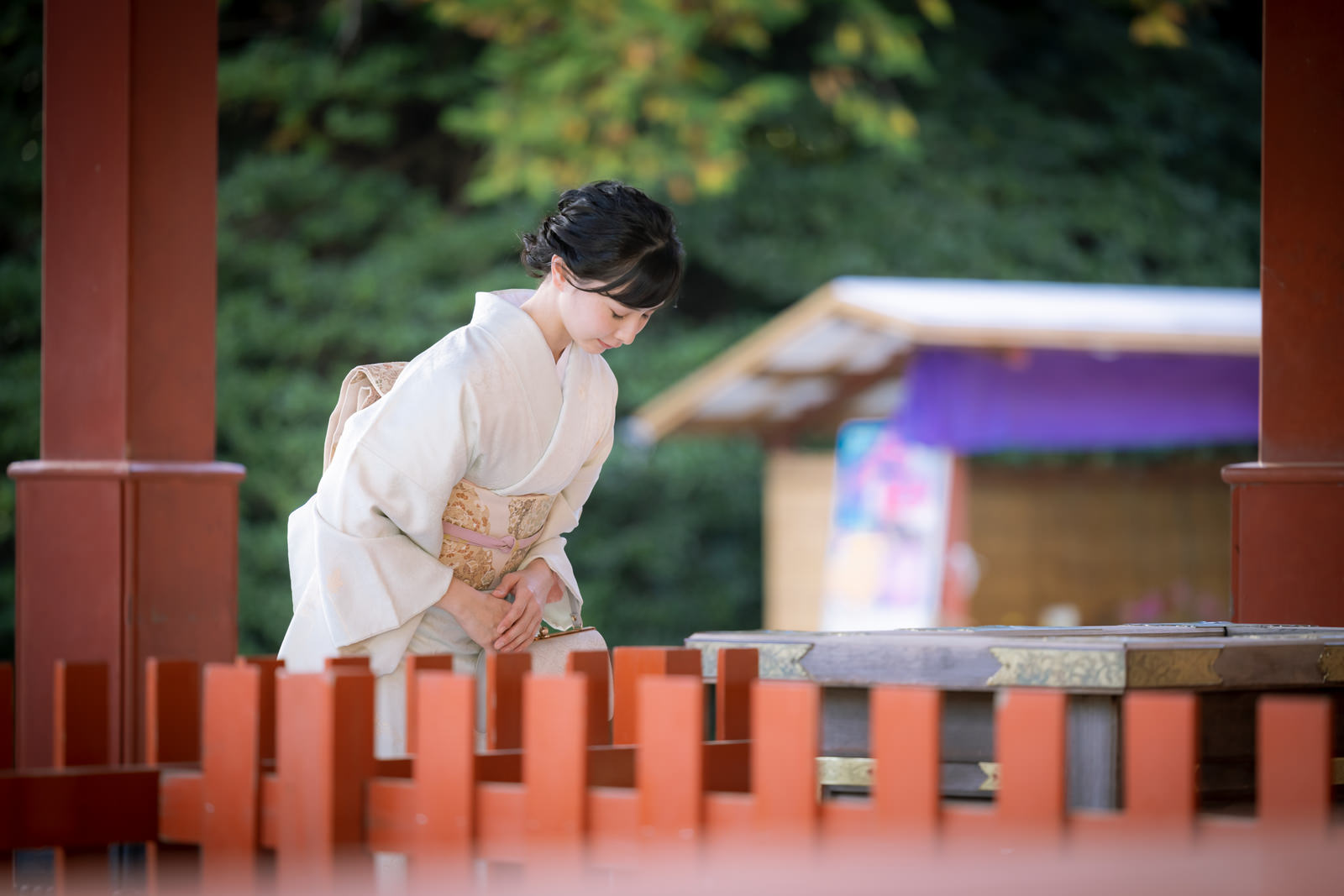
Oji-gi (bowing). Within this fleeting gesture lies a silent reflection of the unique Japanese way of engaging with the world.
Bowing is one of the most recognizable gestures associated with Japan.
It is often exaggerated in imitation, sometimes reduced to a humorous stereotype.
To those in Western cultures, where bowing is not part of everyday life, it can appear unusual—at times even excessive.
And yet, in Japan, bowing happens constantly.
On the street, in shops, at work—
It is not something carefully performed each time.
Rather, it is a movement that has settled into the body, emerging almost without thought.
So why do Japanese people bow so often?
This question cannot be answered by etiquette alone.
It leads to something deeper: what the Japanese direct their respect toward, and how they position themselves in relation to the world around them.
Bowing Extends Beyond Human Interaction
Bowing is commonly understood as a gesture of respect toward another person.
In Japan, however, it is not limited to human relationships.
People bow quietly in front of shrines and household altars.
They lower their heads before mountains, the sea, and other elements of nature.
At times, they even bow to tools they have used for many years, or to objects that support their daily lives.

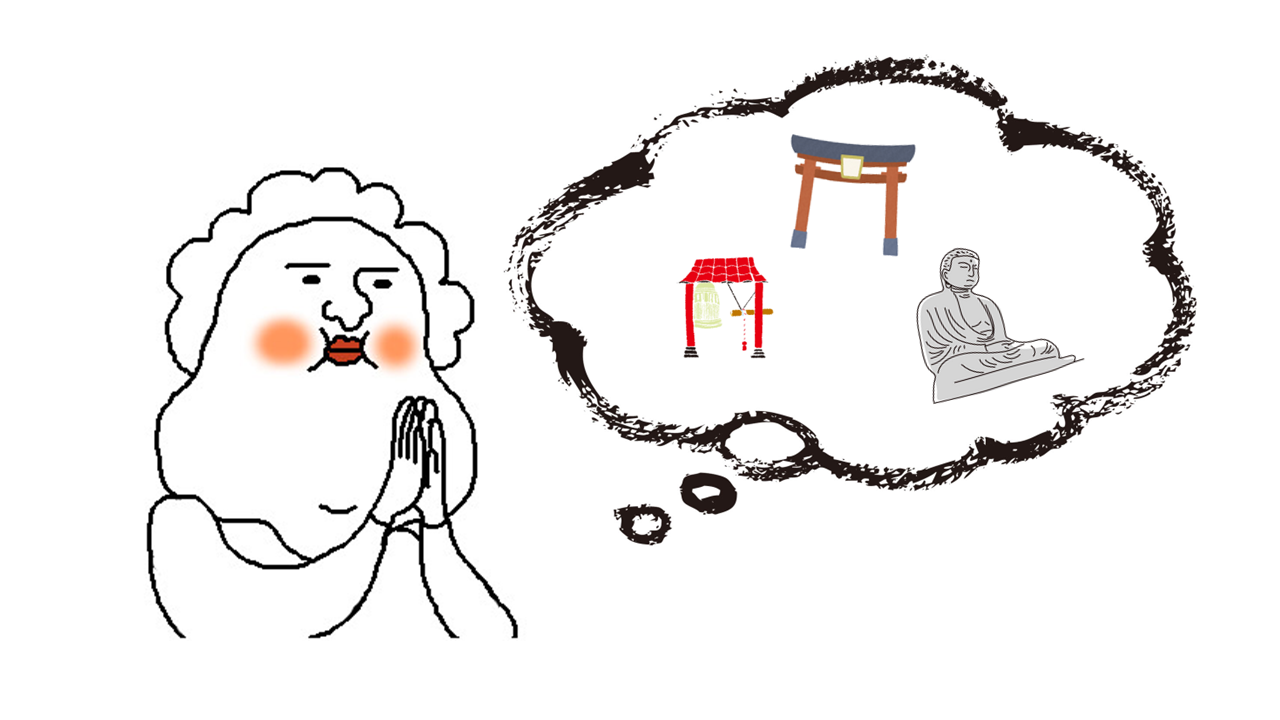
The object of respect is not limited to people. Japanese people bow to all things, believing that “Eight Million Gods” (Yao-yorozu no Kami) reside within them.
These are not unusual or symbolic acts.
They are part of ordinary life.
Bowing, in this sense, is not confined to interactions between people.
It expresses how one faces what exists beyond oneself.
The Thinking That Underlies Bowing
Respect for All Things
In Japan, it has long been believed that not only natural elements—such as mountains, rivers, trees, and stones—but also the things involved in everyday life carry a certain presence.
This idea is known as yaoyorozu no kami, often translated as “eight million gods.”
Here, “eight million” does not refer to a literal number.
It is a way of expressing that countless forms of existence are present in the world.
Rather than separating things into distinct categories, this perspective recognizes that everything exists in relation to everything else.
Each thing has its place and role.
And from that recognition, respect arises naturally.
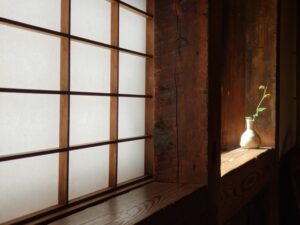
The spirit of Kenjo (humility)—restraining oneself to honor others and maintain harmony with the environment.
Humility as a Form of Beauty
In Japan, value has long been placed on restraint rather than self-assertion.
This is not simply modesty, but a way of maintaining balance within relationships.
Whether in human interaction or in relation to nature, one does not place oneself at the center, but instead acknowledges what surrounds them.
Such a posture is understood as a kind of beauty.
Bowing gives visible form to this attitude.
It appears in everyday moments—when entering a space, in a slight nod when passing someone, when expressing gratitude, when offering an apology, in front of shrines and temples, and before meals.
It is not a special act.
It is woven into daily life.
Bowing is neither flattery nor submission.
It is a way of stepping back from oneself and allowing space for others.
Within that small gesture, respect takes shape.
Why Do Japanese People Bow?
Bowing is a simple movement.
And yet, within it, a particular way of seeing the world can be found.
We live with an awareness that they exist within a web of relationships—with others, with nature, and with the things that support their lives.
Bowing is one way of giving form to that awareness.
It is not merely etiquette.
It is a small, everyday act.
But within that brief moment, something of the Japanese way of relating to the world quietly appears.