Setsubun — “Oni wa soto, fuku wa uchi”
Japan has many annual observances that mark the turning points of the seasons.
Some signal the time for planting or harvest, others are meant to ward off illness and misfortune, while still others reaffirm milestones within the family.
Though their forms differ, all have been handed down as forms of wisdom for regulating the rhythm of daily life.
Among them, Setsubun most clearly embodies the idea of a seasonal threshold.
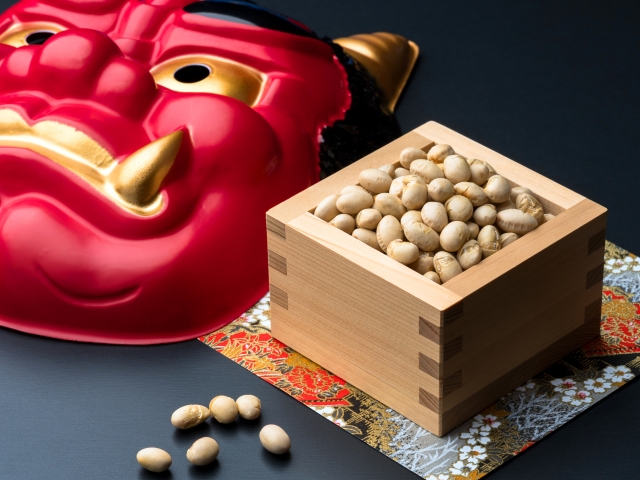
On the night before the beginning of spring, people scatter beans while calling out, “Oni wa soto, fuku wa uchi” — “Demons out, good fortune in.”
By expelling what has accumulated inside the home and welcoming a new flow in its place, Setsubun serves as a moment to reset daily life.
This article traces the origins and customs of Setsubun, exploring why the phrase “Oni wa soto, fuku wa uchi” continues to live on in Japanese households today.
The Origins of Setsubun — The Eve of Welcoming Spring
Originally, the word Setsubun meant “the day that divides the seasons,” referring to the eve of the beginning of spring, summer, autumn, and winter.
Moments of seasonal transition were long believed to be times when climate and physical condition became unstable, allowing disorder to enter everyday life.
As a result, rituals were performed on these eves to ward off misfortune and prepare for the coming season.
One of the ideas underlying Setsubun is Tsuina, a ritual intended to drive away the sources of calamity.
In Japan, descriptions of Tsuina appear in historical records such as the Shoku Nihongi from the Nara period.
Originally practiced at the imperial court, it later spread to the general population, becoming associated with Setsubun as a way of restoring balance within and around the home.
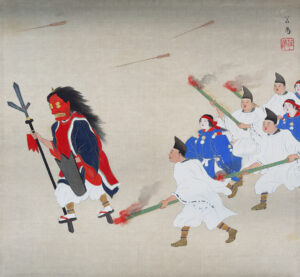
吉田神社追儺
Although Setsubun once referred to the eve of each seasonal change, it gradually became fixed as the day before the beginning of spring.
This was because Risshun, the start of spring, came to be understood not only as a seasonal marker but also as a turning point of the year itself.
Under the traditional lunar calendar, New Year’s Day and the beginning of spring occurred close together, making Risshun a symbolic boundary between years.
On the night before it, people prepared for spring by clearing away what had accumulated and putting their households in order.
In this way, Setsubun took root as a domestic ritual performed on the eve of spring to reset daily life.
The Meaning of Bean-Throwing — “Oni wa soto, fuku wa uchi”
At the heart of Setsubun lies the act of throwing beans.
Calling out “Oni wa soto, fuku wa uchi” while scattering beans clearly distinguishes what is expelled from the home and what is welcomed inside.
Although demons are often portrayed as fearsome beings, in the context of Setsubun they represent illness, misfortune, and disturbances that creep into everyday life, gathered into a single symbolic form.
By giving shape to what cannot be seen and casting it out as an “oni,” space is created within the home to invite good fortune.
But why was the act of throwing beans chosen for this purpose?
One explanation lies in the belief that grains possess the power to ward off harmful influences, with soybeans being familiar and readily available.
Wordplay also played a role: mame (bean) is associated with ma o messuru (“to destroy evil”), and roasting (iru) beans was linked to the phrase ma no me o iru (“to strike the demon’s eyes”).
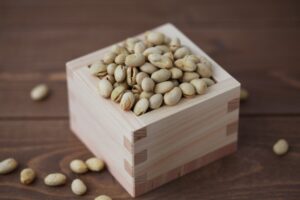
For this reason, roasted beans known as fukumame are traditionally used instead of raw ones.
That said, the type of beans used is not uniform across Japan.
In colder regions, particularly in northeastern Japan, peanuts in their shells are often used.
They are easier to collect when scattered over snow or soil and are more practical for outdoor throwing — an adaptation shaped by local living conditions.
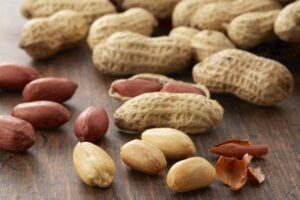
In colder regions, particularly in northeastern Japan, peanuts in their shells are commonly used for bean-throwing during Setsubun.
The act of throwing beans does not end once they are scattered.
Collecting the beans afterward and restoring order inside the home completes the sequence of actions that make up Setsubun.
Ways of Observing Setsubun — Forms That Have Expanded
In addition to bean-throwing, Setsubun includes other customs that have been passed down as part of everyday life.
Ehomaki
Ehomaki is a thick sushi roll eaten on Setsubun.
Typically, it is eaten whole without cutting, while facing the direction known as the ehō for that year.
It is also widely said that one should eat it silently and finish it in a single sitting.
The ehō is not chosen by preference or habit.
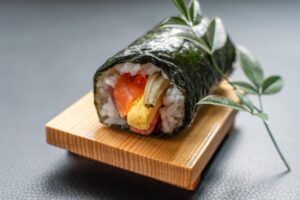
In recent years, a wide variety of ehōmaki—including versions made with seafood or meat—have also become popular choices.
The direction known as ehō is not chosen by personal preference or custom; it is determined in advance based on the traditional calendar.
In Japan, it has long been believed that each year is governed by a deity who determines the flow of fortune, and the direction in which that deity is said to reside is called the ehō.
The method of calculation is the same every year, resulting in one of four directions: east-northeast, west-southwest, south-southeast, or north-northwest.
Ehomaki links this idea of a yearly auspicious direction with food eaten on Setsubun.
However, the reason it is now widely consumed across Japan cannot be explained solely by long-standing religious ritual.
What people ate on Setsubun originally varied by region.
As local food customs were gradually organized into household traditions, ehomaki came to be recognized as a symbolic food of the day.
Today, ehomaki is best understood not as an act of faith, but as a cultural practice that encourages people to pause at a seasonal turning point and realign their daily lives.
Hiiragi Iwashi(holly sardine)— A Protective Charm at the Threshold
Hiiragi iwashi is a Setsubun custom in which the head of a roasted sardine is skewered on a branch of holly and placed at the entrance of a home.
Like bean-throwing, it is performed to prevent unseen misfortune from entering the household.
Each material used carries a clear meaning.
The roasted sardine head emits a strong smell believed to drive away harmful influences.
Holly leaves, with their sharp spines, were thought to repel intruders by causing pain — often described as pricking a demon’s eyes.
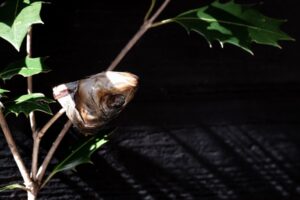
Hiiragi-iwashi, a traditional talisman for warding off misfortune
By combining these two elements, hiiragi iwashi reflects the idea of repelling harm through sensory means.
Placed at the doorway — the boundary between inside and outside — it serves to protect the threshold of everyday life.
What Setsubun Has Left Behind
Setsubun is often described as a ritual for driving away unseen forces.
In practice, it is a form of wisdom that gives shape to disturbances that enter daily life, allowing people to expel them and restore balance.
Scattering beans and gathering them afterward.
Eating a whole sushi roll while facing a fixed direction.
Placing hiiragi iwashi at the doorway to mark the boundary between inside and outside.
None of these actions are dramatic, yet once they are done, the atmosphere inside the home subtly changes.
Pausing on the eve of spring and drawing a clear line in daily life — repeating this act prepares the way for a new season.
For the Japanese, welcoming spring has long carried special meaning.
Setsubun remains a quiet signal guiding everyday life toward that moment.