What Is Japanese Mountain Worship?
Sacred Peaks and the Prayer of Yaoyorozu no Kami
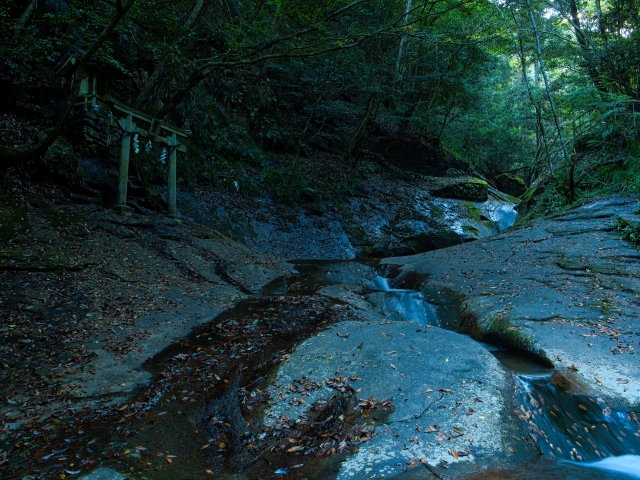
When you step into the mountains, the noise of daily life seems to fall away.
All that reaches your ears is the call of birds, the sound of wind moving through trees, and the feel of earth beneath your feet.
In Japan, mountains have long been revered as places where deities dwell.
Mountain worship refers to a form of indigenous Japanese nature-based belief that regards the mountain itself as sacred — a place of divine presence, prayer, ritual, and spiritual discipline.
The shrines built upon mountains are not incidental structures; they reflect the idea that the mountain itself is holy.
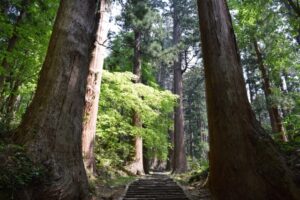
When you walk into the mountains, you may sometimes be seized by a strange feeling, as if you had been cut off from everyday life.
Even those who do not consider themselves religious often speak of a particular stillness or sacred atmosphere when entering the mountains.
Mountains stand close to everyday life in Japan.
Yet despite their familiarity, they carry an undeniable sense of awe. For centuries, people have offered prayers to them, approached them with reverence, and held them in deep respect.
The Origins of Mountain Worship
Japanese mountain worship is closely connected to forms of nature reverence that can be traced back to the Jōmon period (c. 14,000–300 BCE).
Archaeological remains from this era reveal ritual practices directed toward natural phenomena. People understood mountains, forests, rocks, and waterfalls as places inhabited by spiritual presence.
This worldview — that divinity resides within the natural world — later came to be expressed in what is known as Yaoyorozu no Kami, literally “eight million deities.” The phrase does not refer to a fixed number, but to the idea that countless sacred presences inhabit nature.
This concept forms a foundational layer of Shinto, Japan’s indigenous religious tradition.
Among all natural forms, towering mountains held particular significance. Rising between earth and sky, they were seen as liminal spaces connecting human and divine realms.
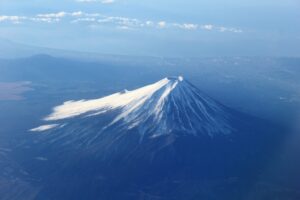
Among Japan’s various forms of nature worship, towering mountains in particular command special reverence as sacred beings.
With the introduction of Buddhism to Japan in the 6th century CE, mountains also took on new meaning as sites of ascetic training.
In particular, Shugendō, a tradition that developed between the 7th and 9th centuries CE, established the mountain as a place where practitioners sought awakening through severe discipline.
Shugendō blends elements of Buddhism, Shinto, and esoteric practices, and its practitioners — known as yamabushi — continue to train in mountainous regions today.
Through these developments, mountains became not only symbols of nature, but also spaces where prayer and spiritual discipline intersected. They came to embody a profound spiritual significance within Japanese culture.
Local Mountain Faiths Across Japan
Across Japan, each mountain region developed its own forms of devotion rooted in local life.
In parts of northeastern Japan, for example, villagers traditionally offer wild vegetables and sake to the “Mountain Deity” in spring, praying for agricultural safety.
According to local belief, the mountain deity descends to the fields in spring to oversee planting and returns to the mountains after the autumn harvest. This seasonal movement reflects the intimate connection between natural cycles and human livelihood.
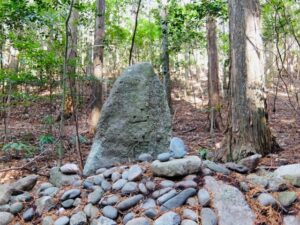
A stone monument dedicated to the mountain deity
In volcanic regions such as Kirishima and Mount Aso in Kyushu, communities long prayed to calm the destructive power of eruptions and earthquakes. The volcano itself was regarded as a deity.
Shrines such as Kirishima Jingū and Aso Shrine stand as testimonies to generations who lived in dialogue with overwhelming natural forces.
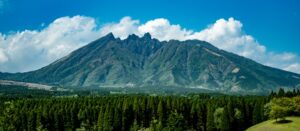
Mount Aso, an active volcano with one of the world’s largest calderas.
In the mountainous areas of Nara, Wakayama, and Mie, as well as in central Japan, yamabushi still undertake ascetic practices. In places such as Yoshino, Kumano, and Mount Ōmine, rituals associated with Shugendō continue, preserving the mountain as sacred training ground.
In every region, mountain worship is inseparable from the lives of those who dwell nearby. Within the quiet of the mountains, one senses layers of memory shaped by generations of prayer.
Sacred Mountains of Japan
Japan has long recognized certain peaks as reizan, or sacred mountains.
Each carries its own legends and spiritual traditions, and many continue to attract pilgrims.
Mt. Fuji
Mount Fuji, Japan’s highest peak, is the most revered sacred mountain in the country.
Historically feared for its eruptions, it was once known as a “mountain of fire.” Ascetics climbed its slopes as an act of spiritual discipline.
Even today, many climb to witness the sunrise — known as goraikō — and offer silent prayers at its summit.

The sunrise viewed from the summit of Mount Fuji
The Three Mountains of Dewa (Dewa Sanzan)
Located in Yamagata Prefecture in northeastern Japan, Dewa Sanzan consists of three mountains: Mount Gassan, Mount Haguro, and Mount Yudono. Pilgrimage across these peaks symbolizes “death and rebirth” — a spiritual journey through past, present, and future.
This region is also associated with sokushinbutsu, monks who pursued extreme ascetic practices in an effort to attain Buddhahood within their own bodies.
After years of disciplined self-denial, some were interred in meditation chambers and preserved as mummified figures.
Their presence reflects the intensity of faith cultivated in these mountains.
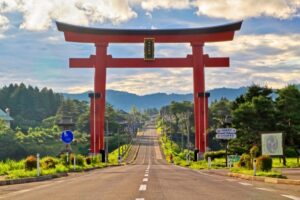
At the entrance to the Three Mountains of Dewa, the grand torii gate of Mount Haguro rises 20 meters high and spans 15 meters across.
Mt. Hakusan
Mount Hakusan in the Hokuriku region has long served as a center of mountain devotion. It enshrines the deity Shirayama-hime Ōkami, a female kami associated with purity.
Covered in snow for much of the year, the mountain’s appearance reinforces its symbolic association with clarity and stillness.
Shrines connected to Hakusan belief spread across Japan, indicating the wide influence of its tradition.
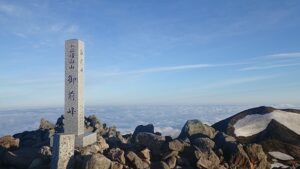
The summit marker of sacred Mount Hakusan, counted among Japan’s three most famous mountains.
The Three Grand Shrines of Kumano (Kumano Sanzan)
Deep in the Kii Peninsula stand three major shrines — Kumano Hongū Taisha, Kumano Hayatama Taisha, and Kumano Nachi Taisha — collectively known as Kumano Sanzan.
At the heart of Kumano faith lies the idea of spiritual renewal.
This does not refer to rebirth after death, but to renewal within one’s present life. Visiting Kumano meant confronting one’s inner state and emerging transformed.
The pilgrimage routes known as the Kumano Kodō are today recognized as a UNESCO World Heritage Site.
Walking these moss-covered stone paths beneath towering cedars, pilgrims encounter a landscape where Shinto and Buddhism intertwine.
Kumano continues to function as a place of prayer — and as a place for inward reflection.
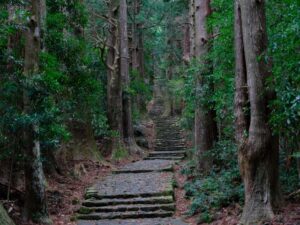
The Kumano Kodo pilgrimage route leading to the Three Grand Shrines of Kumano. Since ancient times, countless people have walked this path on their way to Kumano.
Mountains have long been inseparable from the spiritual imagination of Japan.
People have encountered the divine within them, offered prayer, and treated them as sacred presences. Mountain worship remains a central cultural core embedded within the Japanese landscape.
Even as times change and formal expressions of belief evolve, reverence toward the mountains endures.
It persists not merely as religion, but as a fundamental way of seeing nature in Japan.