Winter in Japan Is Incomplete Without Hot Pot
Winter in Japan cuts straight to the bone.
The sky hangs low, the wind turns sharp, and as the temperature drops, people hurry through their errands and head home as quickly as they can.
In many cities, Christmas lights now brighten the streets. But in snowy regions, under a heavy grey sky and a biting wind, people still return home early, seeking warmth indoors.
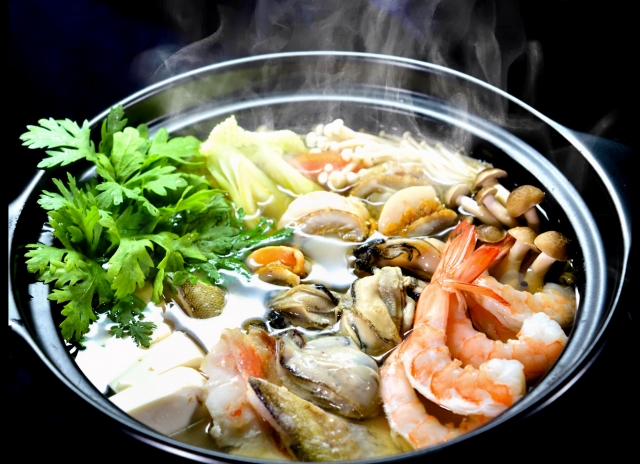
What often waits on the table at such times is nabe—Japanese hot pot.
Japan has many dishes that are famous around the world: ramen, sushi, tempura, and more.
Yet if you ask people in Japan what they crave “once winter really arrives,” hot pot is one of the first answers you will hear.
Families and friends gather around a steaming pot, picking out piping-hot ingredients, blowing on them, and taking a careful bite.
The harsher the cold outside, the more comforting that warmth feels.
For the person cooking, hot pot is also practical.
You slice the ingredients, place them in the pot, set it over the flame, and the meal more or less comes together on its own.
Meat, fish, and plenty of vegetables can all be enjoyed in a single dish, and various leftovers from the refrigerator can be used without waste.
But hot pot has stayed at the center of Japan’s winter table not only because it is tasty and convenient.
A single pot is shared by everyone.
Someone adds more ingredients, someone ladles out soup, others pass bowls and chopsticks. Conversation flows naturally, laughter breaks out, and for a while the cold outside feels very far away.
Hot pot is a dish for enduring winter, but it is also something that quietly warms the heart.
From Ancient Hearths to the Modern Table: A Brief History
The roots of hot pot in Japan reach back as far as the Jōmon period.
People were already using earthenware pots to boil and stew ingredients over an open fire. In that sense, the basic idea of “gathering around a pot” has been part of life in Japan for thousands of years.
Japan’s hot pot culture, however, developed significantly from the Yayoi period onward (around the 3rd century BCE to the 3rd century CE), when iron cookware was introduced.
Iron pots offered better durability and heat retention, making simmered dishes even more practical.
Throughout ancient and medieval Japan, boiling and simmering were central cooking techniques.
In aristocratic residences during the Nara and Heian periods, food was prepared over charcoal and in large hearths. In ordinary homes, however, a sunken hearth known as an irori came to occupy the center of the living space.
The irori provided warmth in winter and served as the main cooking area. Pots were hung over the fire, and family members naturally gathered around it.
Within this setting, the style of sharing a pot and eating together took shape as part of everyday life.
Today, some traditional inns and restaurants still use irori hearths, allowing guests to experience this older way of cooking and eating that lies behind modern hot pot culture.
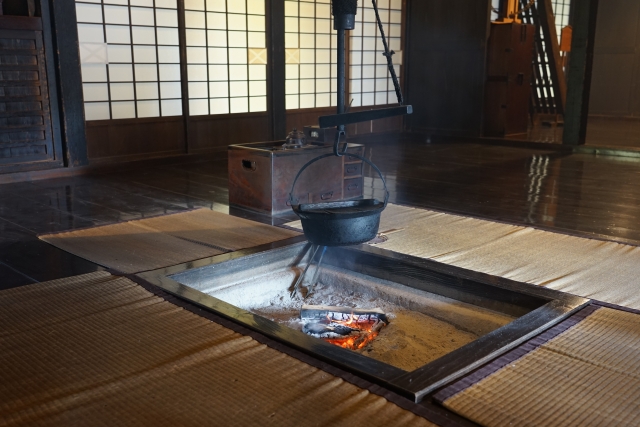
Traditional Japanese irori hearth, used not only for warmth but also for cooking.
Signature Hot Pots from Around Japan
One of the great appeals of hot pot in Japan is its regional diversity.
Each area has developed its own style based on local climate, available ingredients, and everyday life. Here are some of the best-known examples.
Hokkaidō – Ishikari Nabe
Ishikari nabe is a representative hot pot of Hokkaidō, made by simmering salmon in a miso-based broth.
The richness of the salmon and the depth of the miso create a hearty flavor that suits the cold northern climate.
Typical ingredients include cabbage, leeks, onions, mushrooms, and tofu. Some households add a small amount of butter at the end for extra aroma and body.
Because the broth is drawn from the salmon itself—often including bones and trimmings—it is a dish that makes generous use of the fish while being easy to prepare at home.
※For more on Ishikari nabe, see the separate article:Exploring the Flavors of Home – Hokkaido Edition
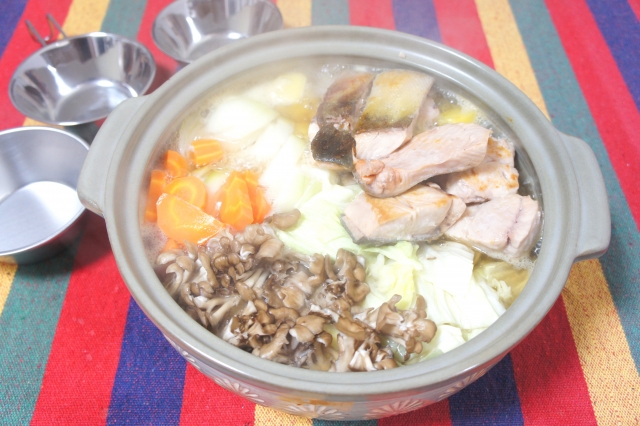
Ishikari nabe, a traditional hot pot from Hokkaido.
Akita – Kiritanpo Nabe
In Akita Prefecture, kiritanpo nabe is a classic winter dish.
Kiritanpo are cylinders of mashed rice wrapped around skewers and grilled, then cut and simmered in a chicken-based broth.
As the rice soaks up the soup, it becomes tender yet satisfyingly chewy.
The charm of this hot pot lies less in the luxury of the ingredients and more in the quality of the broth itself.
The stock is often made with Hinai-jidori, a local chicken prized as one of Japan’s top native breeds.
Fragrant vegetables such as burdock root, leeks, wild parsley (seri), and maitake mushrooms are added, bringing together the flavors of field and mount
According to a well-known explanation, kiritanpo began as a practical way for people working in the mountains or hunting to carry cooked rice, which later evolved into a hot pot dish prepared at home.
※For more on Kiritanpo nabe, see the separate article:Exploring the Flavors of Home – Akita Edition
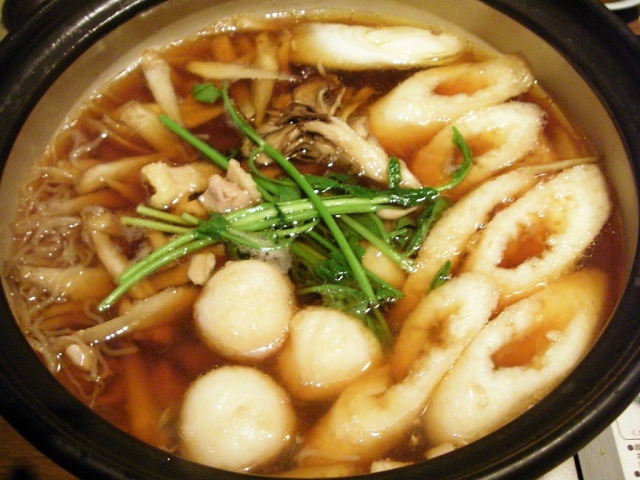
Kiritanpo hot pot, a local specialty of Akita.
Fukuoka – Motsu Nabe
Motsu nabe is a hot pot made with beef or pork offal, simmered together with garlic, cabbage, and garlic chives.
The sweetness of the rendered fat enriches the broth, and the generous amount of vegetables makes it both hearty and balanced.
Seasonings vary by shop and household: soy sauce, miso, or salt-based broths are common. Chili peppers and yuzu pepper are often added to tighten the flavor.
A typical way to finish the meal is to add champon noodles to the remaining broth, making use of every last drop of flavor.
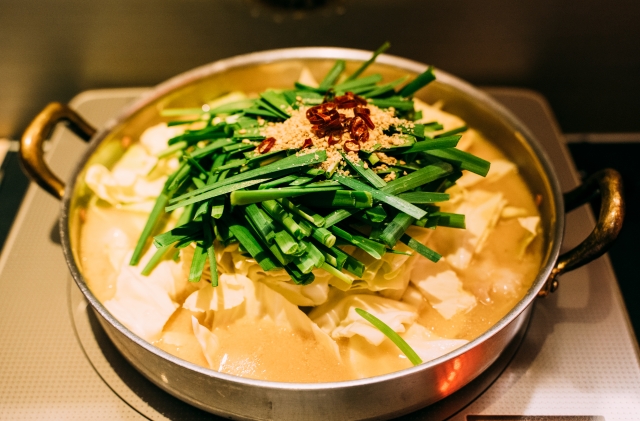
Motsu nabe, a hot pot now beloved across Japan, not just in Fukuoka.
Yamagata – Imoni
Imoni is a taro-based hot pot that is a seasonal tradition in Yamagata Prefecture.
Taro, meat, konnyaku, and leeks are simmered together, with the seasoning differing by region.
In inland areas, a soy-sauce-based broth with beef is common, while in coastal areas, a miso-based broth with pork is often used.
Despite the differences, both styles are firmly recognized as “imoni.”
In autumn, riversides become gathering places for imoni-kai—outdoor imoni parties where people cook in large pots over an open fire.
The sight of steam rising from a huge pot by the river has become a familiar seasonal scene in Yamagata, symbolizing the arrival of autumn and the beginning of the cold months.
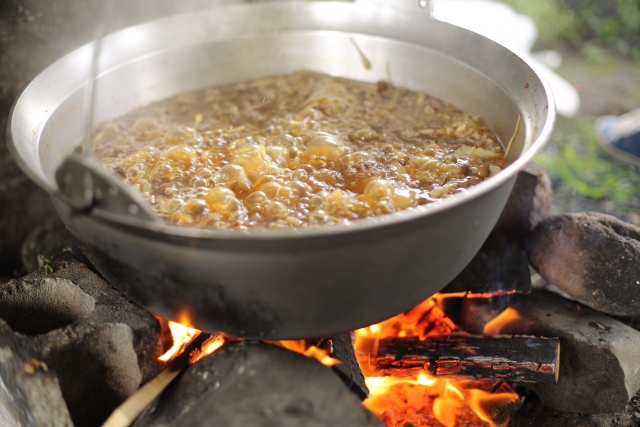
At riverbank imoni gatherings, the stew is cooked in large pots.
Chanko Nabe – The Sumo Stable Hot Pot
Chanko nabe is the general term for hot pot served in sumo training stables.
Rather than a single fixed recipe, it refers to a style of cooking: a rich broth filled with meat or fish, tofu, and large quantities of vegetables.
Nutritional balance and volume are central concerns, and each stable and each stablemaster has its own preferred flavor.
One often-heard explanation is that chicken is favored because a chicken “stands on two legs,” symbolizing not falling down, but this is one of several interpretations handed down within the sumo world.
Today, chanko nabe has moved beyond the ring, and many restaurants serve it as a filling, communal dish that reflects the spirit of sumo culture.
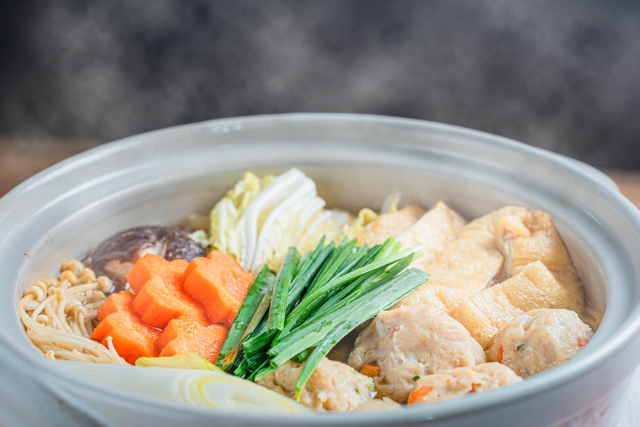
Chanko nabe, a staple dish in sumo stables.
Hot Pots with Overseas Roots
In recent years, hot pots originating from abroad have also become part of winter dining in Japan.
Korean-style dishes such as kimchi jjigae bring together the tang of fermented kimchi and a deep spicy heat, pairing well with pork, tofu, and leeks.
Dishes inspired by budae jjigae or cheese-topped spicy hot pots have also become familiar, especially among younger diners.
These hot pots differ from traditional Japanese nabe in flavor profile, but they fill a similar role: a shared, warming dish that brings people together around the table in winter.
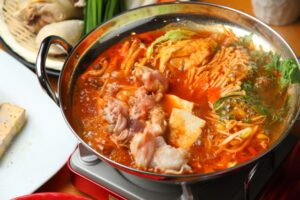
Kimchi jjigae, a popular Korean hot pot–style stew.
How Hot Pot Supports the Winter Body
The appeal of hot pot goes beyond taste and atmosphere.
It is well suited to supporting the body during the cold months.
Warming from the Inside
Winter cold lowers not only the temperature of the air but also the core temperature of the body.
Because many health issues are linked to feeling chilled, dishes that can be eaten hot, down to the last sip, become especially important.
Hot pot warms the body from within.
Steam rising from the pot softens the air around the table, and even the act of leaning in and sharing the dish contributes to a sense of warmth.
Making the Most of Ingredients
Hot pot is fundamentally a “simmered” dish.
As vegetables, mushrooms, meat, and fish are cooked, their flavors and nutrients dissolve into the broth.
By drinking the soup along with the solid ingredients, people can enjoy both taste and nutrition without much waste—a natural advantage in a season when the body needs to stay resilient.
A Dish That Creates Conversation
Perhaps the greatest strength of hot pot is that it naturally creates communication.
One pot is shared by everyone.
People reach for ingredients, pass bowls, add more vegetables, or adjust the heat. These small actions become invitations to talk.
Because everyone eats from the same pot, there is a sense of “being in this together” that is different from eating individual plates in silence.
Even without special effort, conversation tends to arise: about the day’s events, about the taste of the broth, about memories of other winters.
In this way, hot pot is not only a dish but also a kind of social space at the table.
Every household in Japan seems to have its own memories of hot pot.
The mixed-ingredient yose nabe you ate as a child at home.
The spicy hot pot you shared with friends while laughing late into the night.
The first time you tried a local specialty nabe while traveling in winter.
Hot pot remains in memory not only as a flavor but as a scene: who was there, what was said, how the steam fogged the windows.
This winter, what kind of hot pot will you gather around?
A single pot placed at the center of the table is enough to bring people together, warm both body and spirit, and quietly shape the memories of another winter in Japan.