Kintsugi ── Transforming scars into beauty.
There are times when a cherished vessel breaks in an unexpected moment.
When faced with a broken piece, we feel a certain sense of loss.
This is not limited to objects. People naturally feel unease when something breaks or is lost.
Perhaps it is because it feels as though not only the object itself, but also the time and memories layered within it, have been lost as well.
Yet such moments can be viewed from a different perspective.
Instead of seeing the fact that something has broken as “loss,” it can be received as “change,” and from there, new value can be found.
Kintsugi, a traditional Japanese method of repair.
Within it lies a philosophy that finds value in things as they change.
The Craft of Kintsugi — Embracing Damage and Transforming It into Beauty
Kintsugi is a technique that restores broken vessels so they can be used again.
Each fragment is carefully gathered and rejoined with lacquer.
Once fully dried, the seams are refined and finished with gold or silver powder.
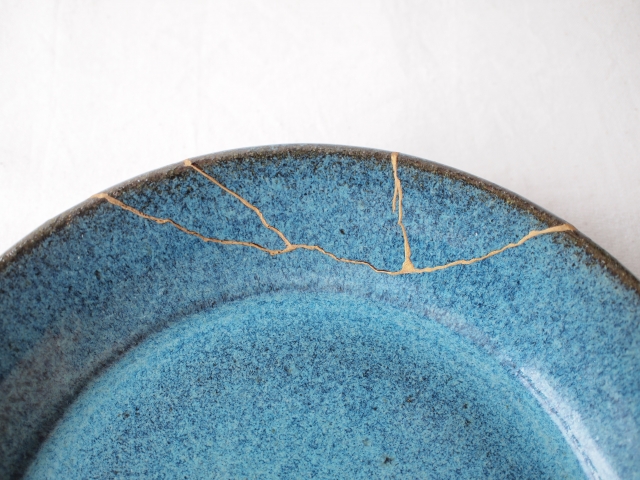
The cracks are not hidden; they remain and shine as part of the vessel itself.
In many forms of repair, the damaged areas are blended in so they become as unnoticeable as possible.
Kintsugi, by contrast, leaves the joins visible, emphasizing their lines.
The cracks reflect the time the vessel has lived through.
With the application of gold or silver, a new kind of beauty emerges—one different from what it was before it broke.
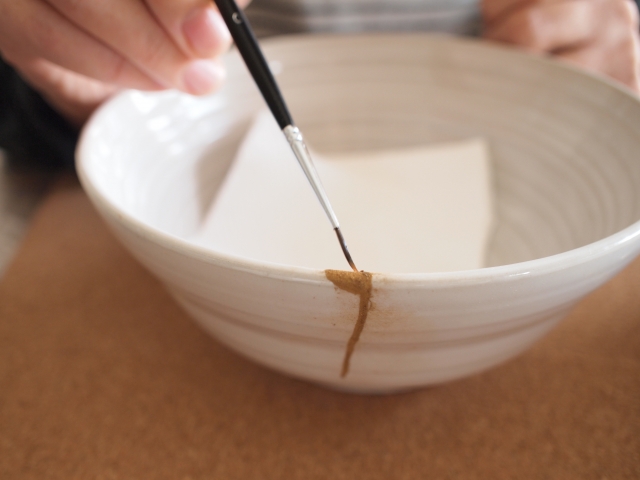
Blowing new life into the scars with gold, rather than hiding them.
Why Leave the Scar
Rather than restoring something to its original state, kintsugi preserves the traces of what has happened.
This way of thinking is far from ordinary.
Why is such a choice made?
At its core lies the understanding that all things continue to change.
Anything with form will eventually transform; nothing remains the same forever.
If so, instead of forcing what has changed back to what it once was, one accepts the fact of that change itself.
Cracks and chips are not something lost.
They are the marks of change that have occurred in the life of the object.
Underlying this way of thinking is the idea of impermanence—the belief that everything is in a constant state of flux.
At the same time, it reflects an attitude of not resisting change, but accepting things as they are.
Kintsugi goes beyond a mere repair technique.
It embodies a distinctly Japanese way of thinking—one that embraces things as they change, just as they are.
The Spirit of Wabi-Sabi in Kintsugi
Behind kintsugi lies wabi-sabi, a uniquely Japanese aesthetic.
Wabi refers to stepping away from extravagance and finding richness within simplicity and quietness.
Sabi is the appreciation of age and wear—seeing the patina of time not as decline, but as depth.
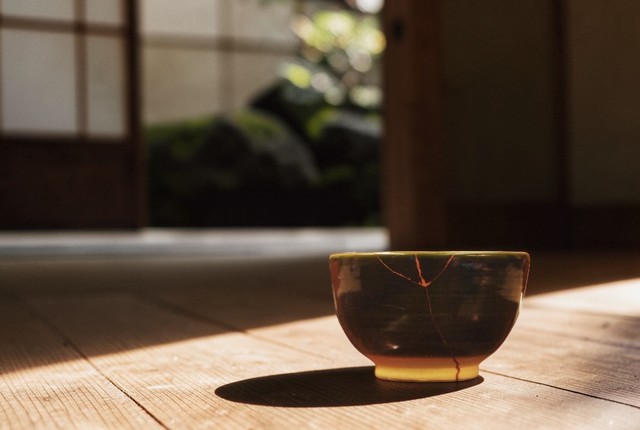
A cracked tea bowl, a moss-covered stone lantern, worn tatami edges, a slightly faded hanging scroll—
none are perfect like something new, yet each reflects the accumulation of time.
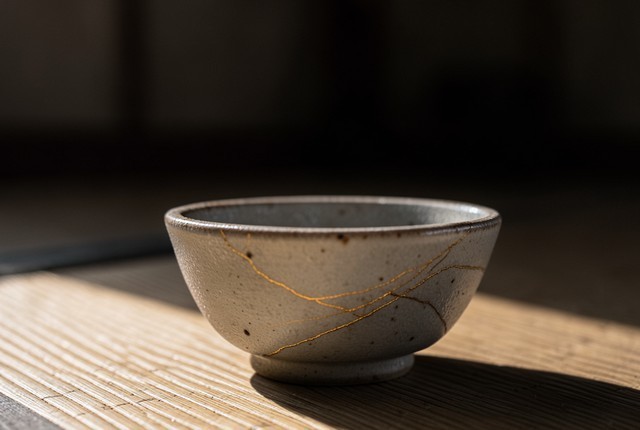
The depth of accumulated time residing in things that are not perfect.
Wabi-sabi is not about perfection, but about finding value within imperfection.
The vessel, in its imperfect state, is itself part of what has been shaped and nurtured over time.
When Imperfections Shine
Just as a vessel breaks, so too does the human heart crack again and again over the course of life.
Failures, setbacks, partings, and loss—
these experiences remain within us, changing form but never truly disappearing.
When we are hurt, we tend to hide it.
We may distance ourselves from past pain and carry on as if nothing had happened.
Yet kintsugi offers another way of receiving such experiences.
Instead of concealing cracks and fractures, it accepts them as they are.
And it transforms those traces into part of one’s own beauty.
Flaws and failures do not end as mere negatives.
With a shift in perspective, they can become strengths that belong only to that individual.
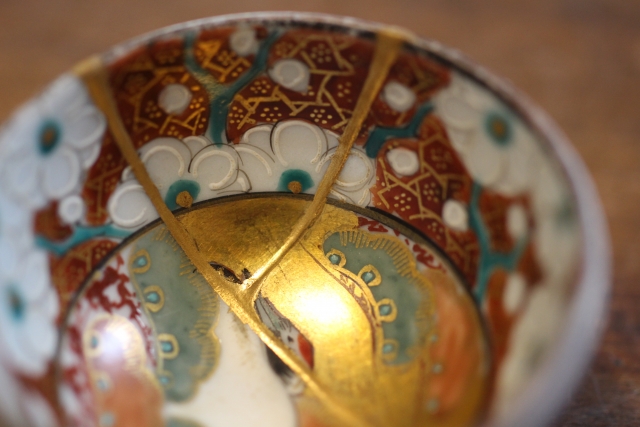
Your scars become a singular radiance that defines who you are.
Kintsugi, a traditional Japanese method of repair.
It is not a technique for returning something to its original state.
What resides within it is a Japanese aesthetic—one that finds value in things as they change.